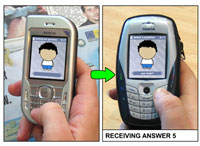
 Dysfunctional drunks, lurking loners and nervous nerds need no longer feel alone thanks to a new mobile phone guessing game called YOU-WHO.
YOU-WHO is a social game for mobile phones that is billed as acting as a “gentle introduction for strangers.”
The software uses the personal area networks created by Bluetooth technology to introduce players to weird geeks, desperate losers, lonely psychopaths, fellow game players in their locality.
The game can be played in any public space where Bluetooth-enabled folks might lurk – train stations, airports, cafés, bars, dark alleyways etc – and supports multi-play gaming.
After two players have agreed to take part in the game, one player will take on the role of ‘mystery person’, gradually feeding clues about their appearance to the other player, who builds up an Anime-style picture on their screen using (ahem) a “million-billion character combinations”.
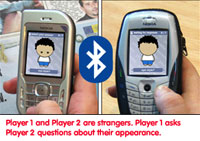 Once a set number of clues have been given, the players’ phones ‘call’ to each other with a distinctive sound, thus revealing both players’ locations and identities, quickly followed by screams of “Aaaargh!” Get away from me you weird freakshow nerd!”
Billing their game as a “New Type of Social Network Game”, YOU-WHO claims that their game encourages “players to explore their social environment and to take risks”, and that their technology “uses Bluetooth to re-open these social spaces for new chance encounters.”
We’ve always thought that going up to interesting-looking people and just talking to them does the job for us, but no doubt some teenagers might prefer to sit in a corner slumped over their mobile phone instead.
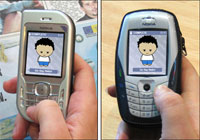 You-WHO is offered as a free 28 day time-limited demo. The cheery young developers at AgeO+ hope to have a full commercial release soon.
The software won the Submerge Graduate Awards, a cross-format competition based in the South West of England. If you’ve a penchant for tiny text, pointless animation and fiddly Flash websites, you’ll love their Website
 Buying goods with your PC may soon be as hip as dancing to a Chris De Burgh remix if the latest innovation from Yahoo Japan takes off.
 It can be a confusing life for protesters keen to voice their opinions at the G8 meeting in Gleneagles.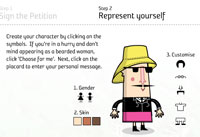
 All those signing up will have their names added to the online petition, the Live 8 list, which is being sent directly to the G8 leaders.
 The European Parliament has voted overwhelming against a controversial bill that might have led to software being patented.
 The bill was supposed to get rid of individual EU nations’ patent dispute systems and replace it with a common EU procedure. Instead, the old system of patents being handled by national patent offices will continue, without any judiciary control by the European Court of Justice.
 A report in German news magazine Focus states that the German Federal Ministry of Transport, Building and Housing will be lifting its ban on the use of mobile phones on commercial flights.
 The technology for providing in-flight GSM coverage is already in place, with Swedish vendor Ericsson recently announcing a newly developed ‘GSM on Aircraft’ system.
 Abertis Telecom, Nokia and Telefonica Moviles Espana have emerged smiling from a big converging huddle with news of a mobile TV pilot using Digital Video Broadcasting-Handheld (DVB-H) technology.
 These will be equipped with a “special accessory” to receive the mobile TV broadcasts.
 Outdoor and indoor signal and broadcast quality will also be tested to help fine tune the best technical parameters for the viability of DVB-H based services.
 Around a hundred rural African farmers around Makuleke are testing cell phone technology that gives them access to national markets via the Internet, allowing them to compete with the big boys and boost profits by at least 30 percent.
 It’s believed that wireless technology is the best way to bring the Internet to the poor, as Africa’s sparsely-populated and often inhospitable landscapes make a landline infrastructure commercially unviable.
 There’s a hard business ethic at work here, with the companies keen to expand the cell phone market into rural areas and grab new customers before the competition steps in.
 It used to be that attending a festival was more akin to a long trek in a distant country, with festival-goers vanishing for days on end, uncontactable by the outside world.
 Like Glastonbury, Live 8 and several other big music festivals, band’s performances at the Reading Festival will be available to view over the Web via a streaming Webcast, with official sponsors Tiscali providing the coverage.
 The festival, now corporate branded into the “Carling Weekend Reading Festival”, takes place over the August bank holiday weekend.
 China has opened its first officially licensed clinic for Internet addiction as State media reports growing cases of obsessed Internet gamers whose addiction has caused them to quit school, commit suicide or
 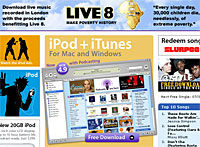 Hot on the heels of the hugely successful Live8 concert in London, Apple’s iTunes Music Store has made the opening performance of The Beatles’s “Sergeant Pepper” (sung by McCartney with U2) available for purchase through its store.
 Distribution is to be exclusively digital, so there will be no physical product. All profits are to be donated to Live 8, “and the fight for the future of Africa”, according to the iTunes Website.