 Over here in Digital-Lifestyles land, we’re always getting our ears bent by some PR-type banging on about how mobile TV is going to be “the next big app” to hit handsets.
Luxembourg (amongst others) have already broadcast trials and commercial pilots, and now Singapore mobile operator M1 is getting in on the act, airing previews of its made-for-mobile TV drama.
The service, snappily dubbed “3G TV”, is the result of a partnership between MediaCorp Studios, the Media Development Authority of Singapore and M1. The trio are hoping to flog off the series to other operators in the region.
With mobile TV slowly coming up on the consumers’ radar, high quality content will be a critical factor on whether the service takes off, so mobile companies and TV content owners are keen to do lunch, chew the fat and go for a synergetic workout afterwards.
Mr P Subramaniam, director of M1’s sales and marketing department served up this pearl of wisdom to Channel News: “What’s more important here is the whole revolutionary concept behind this, how consumers look at it and take it up. And that’s where it’s going to get really exciting.”
 M1 and its partners plan to knock out dramas with a specific mobile version, which will be different to the regular TV episodes, allowing viewers the choice of watching a broadcast TV version or an extension of the same show on mobile.
The first drama to emerge from this collaboration, titled “PS I Love You”, is due to appear on mobile phones in Singapore by June of this year.
Not everyone is convinced that creating custom drama content for mobiles is going to be a monster hit, but with mobile companies, TV content owners and producers are keen to test the demand for this potentially lucrative new outlet.
More collaborations are expected to emerge in the forthcoming months.
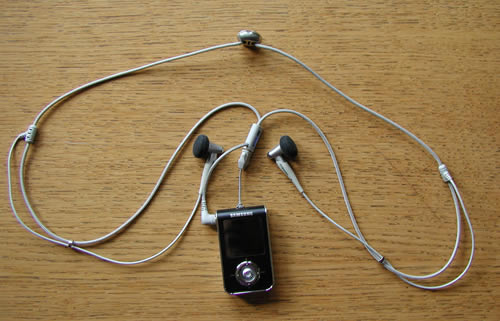
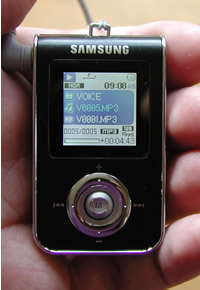 Samsung have made their intentions clear. They want to be the number one in portable music players.
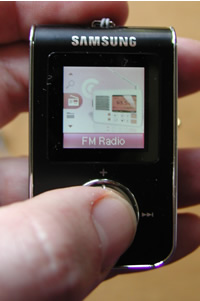 The potential of the 65k colour screen is well demonstrated by the graphically-rich menuing, but when you try to display photos and text files on it, its limitations are highlighted – it’s just too small, and when loading images, slow.
 Pro
Pro 
 Champagne corks were popping like manic machine gun fire at Google yesterday as the company reported a thumping fivefold increase in profits in the first quarter.
 Revenues generated from Google’s partner sites through its AdSense programs generated $584 million, or 47 percent of revenues, – a hefty 75 percent increase over partner-related revenues a year ago.
 Unlike several telecoms companies in the US who are hell bent on blocking free Wi-Fi hotspots, BT has stated that it has “no problems” with the concept.
 The network covers the length of Upper Street – one of the busiest streets in Islington – with the Council donating PCs to some local businesses as part of its push to boost economic activity in the area and to encourage local residents onto the Internet.
 Clark does not envisage US-style legal wrangling in the future for the UK and expressed confidence that if more people use Wi-Fi it will drive demand for BT’s services.
 ITN is set to steal a march on its rivals by delivering up-to-the minute election analysis and comment through a partnership with Vodafone Live!
 Nicholas Wheeler, managing director of multimedia content at ITN, commented: “This is a new facility using mobile technology that was not available at the time of the last election.”
 Web search goliaths Google have delivered a large size nine up the rear end of their fierce rivals Yahoo by being the first to launch a local search service in Britain.
 “It’s the first time we’re bringing local search to a country outside North America,” said Kate Burns, ad sales and operations manager for Google in Britain, declining to give details about launches elsewhere in Europe.
 Global search advertising revenue is already sending cash tills into overdrive, with US investment bank Piper Jaffray estimating spending to rise to US$7.9 billion (£4.1BN/€6bn) in 2005 from US$5.5 billion (£4.1bn/€4.2bn) in 2004 – with most of the growth coming from international expansion and higher volume.
 After years of throwing pans at each other, Sony and Toshiba are set to kiss and make up and develop a universal standard for next-generation DVDs, according to a report in the Nihon Keizai Shimbun business daily.
 Two competing formats developed out of this technology, with Sony and Matsushita (Panasonic), introducing the Blu-ray standard in February 2002, with Toshiba and NEC Corp. following with the HD DVD standard.
 A coalition of government policy makers, technology and broadband companies from China have rocked up to the NAB2005 Media Show in Las Vegas.
 Motorola handset owners will now be able to go multiplayer bonkers, courtesy of a new selection of real-time, multiplayer games from Motorola’s consumer portal, www.hellomoto.com.
 As well as playing directly against other phone users, game-hungry portal visitors will also be able to compete in ladder tournaments, view global rankings and chat in-game.
 “This represents another major step forward in the development of Terraplay given the stature of Motorola in the global wireless market. Motorola’s initiative is excellent news for the growth of the multiplayer sector,” purred Jeremy Lewis, Chairman of the Advisory Board, Terraplay Systems, “Multiplayer gaming, offered as premium services, is a real revenue generator and an ideal path to higher ARPU for all service providers”.
 The latest National Statistics monthly update to the survey of Internet Service Providers (ISPs) shows that there was a 1.9 per cent increase in the number of active subscriptions to the Internet in the past year (Feb 2004 – Feb 2005)
 Permanent Internet connections rose to 43 per cent of all subscriptions in February 2005 (up 2 per cent from Jan 2005) with a year on year increase of 85.9 per cent for subscriptions for permanent connections.