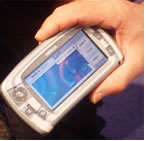
 The BBC needs to move fast to create suitable partnerships to be able to ride the new wave of ‘TV on the go’. That’s my conclusion after attending a recent IIC event last week (that’s the International Institute Of Communications to you). There I can reveal I was drawn into what felt very much like a mobile content ‘love fest’.
Representatives from a diverse group of media industries including MTV and BT were prophesizing mobile TV is the saviour of TV. Trials in Europe have indicated that across the continent viewers can’t get enough of TV on a tiny little display on their phones and this isn’t just the ‘bite sized’ mobile episodes that commentators had been predicting. It appears that mobile TV is able to actually increase the number of hours that viewers consume, which many thought had peaked.
With this new form of TV, it is said ‘you no longer need to be a couch potato, you can be a potato anywhere’ so expect many hours of work to be lost to must watch TV phenomena like ‘I’m a celebrity’ and ‘Big Brother’.
Channel 4 New Media has recently announced the launch of a mobile TV channel dedicated to Channel 4 content on mobile phones. Sky is planning a 19 channel launch in conjunction with Vodaphone and an ITV mobile service has been announced.
The mobile manufactures need to provide the right interface with an easy to navigate EPG and the content needs to be held securely on the device it’s downloaded to minimise the potential for sharing.
All the big players have a keen interest in the success, from the handset makers, the telcos and of course, the content owners who will expect to negotiate a premium for their programming. The players are going to have to effectively perform a ‘land-grab’ to make sure that an ‘ipod’ like solution does not steal their planned-for bonanza.
Where though does a Public Service Broadcaster fit into this increasingly monetized market? The BBC has been looking at DAB technology providing ultra local TV, but this is unlikely to the drive young affluent consumers who are the usual early adopters of new gizmos.
We are consistantly drawn back to the same conclusion with Mobile TV. This content may be offered; handset makers can produce the equipment; consumers may dabble with it if it costs them nothing.
The still unanswered question is, will the consumer put their collective hands in their collective pockets to pay for it?

 Partially arguing against the UK ban on advertising by organisations that attempt to “influence public opinion on a matter of controversy”, she says her group will challenge the ban. Allen is right in some respects when she says:
 Much has been made of what have been reported as poor results at BskyB (Profits announced on Friday 4 Nov 05 saw a pre-tax rise of 13.6% to £200m), intense competition is given as the cause of the lower than hoped for growth in subscribers.
 Most would consider a UK satellite rival needs to be positioned to use the same satellites as Sky services that’s Eurobird and Astra 2. If you move away from their orbital positions, you’re going to have to duplicate a whole load of services across two platforms with the expense that will entail.
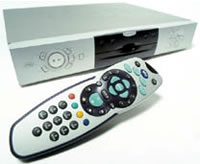 The other group that would be interested are the ‘churn’ which are now reported by Sky as around 11%. These are subscribers who are leaving their Bskyb packages – but they’re really already on the Sky Freesat as unless someone comes and takes away their Set- top-box and mini-dish. They’ll get many of the FTA (Free To Air) services like ITV3 that aren’t available on analogue terrestrial and, for a small charge, can obtain a viewing card that will allow them to view those encrypted services like Channel 5, Channel 4, ITV1 and ITV2.
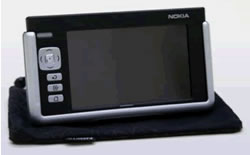 We first reported the news of the
 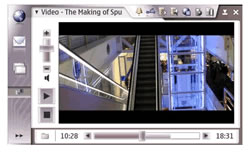 Well today, Nokia are announcing its actual availability and they’ve expanded its capabilities to enable Web browsing using Bluetooth via your mobile.
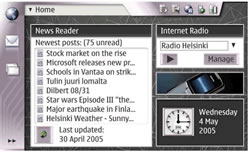 For Linux hackers everywhere, there’s the great excitement that the 770 will be running Debian Linux, with the new platform – derived from the Linux GNOME UI – going under the name “maemo”. Development on maemo has continued since May and the end of October saw the release of maemo 1.1 Release Candidate 5. They’ve even given it the fancy new name of Nokia Internet Tablet 2005, if you please.
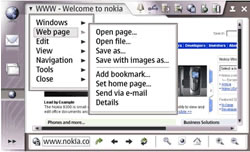 VoIP was hinted at back in May. It’s now been confirmed by our old mate Janne Jormalainen, “During the first half of year 2006 we will launch the next operating system upgrade to support more presence based functionalities such as VoIP and Instant Messaging.”
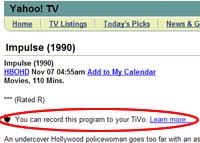 TiVo and Yahoo are linking up to provide a reasonably extensive collaboration.
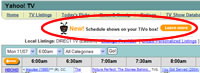 We understand that both companies see this as a cross-promotion service, so moines haven’t been exchanged. Proof of the promotion for TiVo are see at the bottom of the Yahoo page explaining the service, where non-TiVo owners are given the chance to buy a machine for $49 after rebates.
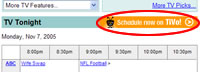 The programming your Tivo remotely part of the deal mirrors the deal they did with AOL a number of years ago, but as we mentioned, gives Yahoo an output in peoples TV rooms.
 Hash showed off Animation Master which is a very simple (if you believe the demos) animation package. It has a huge library of pre-built characters, objects and even things like types of walks for the characters. Lip syncing even looked easy. Though the package is simple, you probably need some basic creative skills and understanding of animation to do anything sensible with it. Visit their Website and look in the gallery, the video of “I will survive” of Gloria Gaynor fame is a true classic.
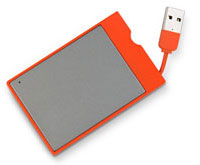 LaCie had lots of disk systems on offer (firewire, USB and Ethernet) offering easy access to multi-terrabytes of data. An external 5 1/4″ drive (the size of a CD-ROM drive) can hold up to 1TB (big disk) while the double width bigger disk extreme can hold up to 2TB. There’s also external RAID drives, the biggest F800 holds up to 2TB supporting Firewire 800 (up to 80MB/s transfers) and the biggest S25 support 160MB/s and up to 2.5GB (which is 3GB internal) both support hot-swappable drives. The newest addition is the mini which looks just like a Mac mini and sits underneath it (and can be stacked with more minis), each one containing up to 250MB of disk.
 The alleged ‘commander’ of a 400,000 strong botnet has been arrested in the US, in the first US case brought.
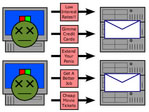 He looks like he’s in pretty big trouble as he’s been charged with 17 counts, including conspiracy, transmission of code to a protected computer, to a government computer, and multiple counts of fraud and money laundering.
 Among the computers infected were some from the Weapons Division of the US Naval Air Warfare Center, and machines belonging to the US Department of Defense’s Defense Information Systems Agency, according to a statement from Debra Wong Yang, US Attorney for the Central District of California.
 Exclusive animated footage from Gorillaz Demon Days Live in Manchester will be available ‘on demand’ via the red button on digital television for seven days, courtesy of BBC Radio 1.
 Dan Duncombe, Digital Media Manager at Parlophone, comments, “Giving fans the ability to access content across a number of digital platforms is a key part of the Manchester events. These shows are groundbreaking and working with Radio 1 has allowed us to take this further in terms of reach as well as interactivity. Gorillaz fans throughout the world can access and interact with this exclusive audio and visual content, making it a truly global and multi platform event.”
 Despite so much current talk from the UK Telco’s and Sky on the magic that will provide an on demand broadcast TV proposition in the UK, tangible evidence of a working model beyond KiT in Hull and Homechoice is pretty sparse.
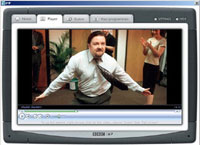 Despite the somewhat limited selection of programmes, which I’m told is largely down to copyright issues, it seems a positive move for a public sector broadcaster actually providing a service and solving the ‘problem’ of letting you see a programme you forgot to record or you later discover is worth viewing.
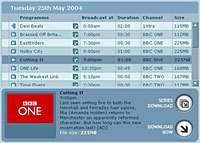 The BBC is thinking beyond the present Windows-only solution. Speaking recently in London the BBC’s Project Director for iMP Ben Lavender reinforced the BBC philosophy of platform agnosticism and spoke of the desire to work on Apple and Linux solutions when DRM issues can be satisfactorily dealt with.