 P2P network, BitTorrent has signed an agreement with the Motion Picture Association of America to collaborate on stopping Internet piracy.
After a press conference, a joint release was released by BitTorrent founder and CEO Bram Cohen and MPAA chairman and CEO Dan Glickman announcing that BitTorrent have agreed to remove all links directing users to pirated content owned by the seven MPAA member companies.
The agreement will effectively prevent bittorrent.com from locating unlicensed versions of popular movies, making it harder for freeloaders to find online illegal copies of films.
“BitTorrent is an extremely efficient publishing tool and search engine that allows creators and rights holders to make their content available on the Internet securely,” Cohen said.
 “BitTorrent Inc. discourages the use of its technology for distributing films without a license to do so. As such, we are pleased to work with the film industry to remove unauthorised content from BitTorrent.com’s search engine,” he added.
Thousand of BitTorrent fans the world over will be clenching their fists and shouting “Traitor! You’re doing deals with the Devil,” while other more balanced, less angry-types will be saying “Smart move Bram, you’ve built a technology that they cannot stop and the fact they’ve done a deal with you proves that. Hey and you’re not getting your shirt sued off your back.”
In September, Cohen revealed that his company had raked in $8.75 million in venture funding to develop commercial distribution tools for media companies, and the MPAA deal looks to be part of a strategy to make the technology more attractive to Hollywood moguls – no doubt with an eye to future lucrative movie download deals.
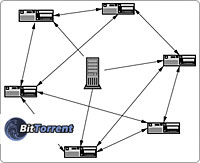
With an estimated 45 million users, the BitTorrent technology pioneered by Cohen does its clever stuff by assembling digital files from separate bits of data downloaded from computer users all across the Internet.
The decentralised nature of technology makes it the easiest, most convenient way to fill your hard drive with dodgy movies galore, while making it harder for Hollywood to find and identify the movie swappers.
In an attempt to stop the piracy, the MPAA has been slapping lawsuits around like confetti during the last year, successfully closing down 90% of targeted sites using the BitTorrent protocol for illegal distribution of movies.
 The MPAA claims that the film industry lost $3.5 billion to movie piracy last year, with a recent study predicting the figure to jump to $5.4 billion this year. The MPAA claim these losses are excluding revenue lost through online file-swapping, so the true figure could be even higher (although other will say the figures are already gloriously exaggerated).
With tears welling up in their eyes, the MPAA said that film copying hurts hundreds of thousands of employees dependent on the movie industry, including sound and lighting techies, carpenters, cinema staff, video store employees and quite probably the popcorn sales assistant too.
But not, we suspect, the fatcat industry bigwigs.
 Because Criminals Make the Best Police Officers
 The other law other are saying have been broken by SonyBMG, and this is one that could land them in BIG legal difficulties, is
  Yesterday, Sky’s takeover of Easynet was finalised and it looks to many that, despite paying a premium on the share price, they’ve have quite a bargain on their hands.
 Although reports that broadband is the latest media battleground have highlighted the moves by the UK telcos, the ultimate prize is the fabled home digital information gateway. The opportunities that this acquisition enables go beyond a mere triple play option (Inernet, TV & Telephone), allowing Sky to, begin by become the overriding aggregator of TV content and, in time, become the preferred digital gatekeeper for many UK homes.
 Submissions should give the name and postal address of the person sending the memorandum and should state whether it has been prepared specifically for the Committee. If the memorandum is from an organisation rather than an individual, it should briefly explain the nature and membership of the organisation. The Committee may publish some of the submissions it receives.
 This weekend, there’s been lots of furious chat on blogs and Slashdot about the EULA that comes with SonyBMG’s audio CDs.
 Many have reacted to RootKit by saying that they feel it is ‘safer’ for them to download their music from unlicensed file sharing services, as they aren’t exposing themselves to unauthorised pieces of software installing on their machines.
 SonyBMG have managed to completely undo the small, patient steps that Sony, the hardware business, has been taking to gathering favour with the equipment buying public.
 Oooh, Conspiracies Abound
 From December 1, all iTunes downloads will carry a new kind of Fair Play DRM, a direct negative feedback ‘watermark’ recognized by Fair Play earbuds and, ultimately, by other audio devices from manufacturers who sign up for the code, which was created under a joint SunnComm and Macrovision venture.
 Intertrust must have though that all of the xmases came at once on the day Vodafone confirmed their licensing deal. It’s not every day that the World’s largest mobile operator signs a deal like that with you.
 The Vodafone deal goes well beyond these basics and licenses all of the technologies and patent that Intertrust have available.
 Both Vodafone and Intertrust declined to reveal the value of the transaction, but given the need for separate deals with the handset companies, it may be here that Intertrust make most of their money. This will not be optional if the handset manufacturers want to be on the Vodafone service and offer content.
 A Hong Kong doleboy has been slapped down by The Man after he was found guilty of distributing three Hollywood films using BitTorrent’s peer-to-peer file sharing technology.
 The OpenSource BitTorrent software has become one of the most popular means of downloading large files, with the technology allowing users to download fragments of a large file from multiple users, rather than in one hefty lump.
 Macrovision, a company who sell content protection (DRM) system, have today released a report they commissioned into content copying.
 This is on the basis of what to us appears, from a quick once over of this report, a pretty unscientific approach, as the following paragraph from page 10 illustrates.
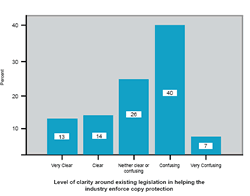 I hope that each time a ‘report’ or so called research like this is published, that it is gone through with a fine tooth comb pointing out its weaknesses. This kind of nonsense needs to be countered.
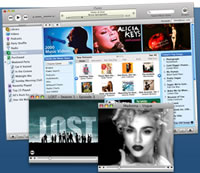 * I downloaded and installed iTunes6. Takes 5-10 minutes. No big deal. iTunes6 has the same basic interface and purchasing/sampling system as previous versions of iTunes.
 * File sizes: Killers video: 20.1 mb; Desperate Housewives episode: 208.6 mb. Both were MPEG-4 video files.
 * I’m sure there are some underlying copyright / “rip-off Britain” issues at play here. I’m just not smart enough to figure them out. But there is a problem when the popular television shows are not available on iTunes-UK and the same music video is 1.89 GBP or about $3.30 – that’s $1.30 extra for each music video that UK customers must pay.