 The battle between Google and Yahoo continues to heat up, with Yahoo ramping up the feature set of its ‘My Web’ suite of personal search tools.
My Web is a personal search engine that lets users save, recall and share resources with others using a selection of Yahoo tools, such as email and IM (instant messaging).
“Yahoo Search is focused on providing innovative, useful technologies that enable people to find, use, share, and expand knowledge,” boomed Salim Mitha, director, Yahoo Search, UK & Ireland.
“My Web is the next step in our vision of integrating search, personal search and community by providing users an easy way to have their own personal web search experience that incorporates the best of the Web and what matters most to them.”
 Yahoo claim that their service is “better than bookmarks”, with users able to save an exact copy of a page along with the link, so that saved content will always be there when users return to the page.
Users can store thousands of pages, with tools allowing users to organise and search the content and access it from any computer.
Shared pages can be published using RSS (Rich Site Summary) with users given the option of creating public links pages.
My Web users will soon be able to share data with the Yahoo 360 social network, which allows users to share pictures, music and other data.
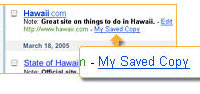 Yahoo’s search history tool bears more than a passing similarity to the one released by Google last week and reflects the fierce competition between the two companies.
Yahoo are hoping that these new features will send people flocking to their portal services and thus generate lots and lots of lovely advertising revenue.
UPDATE: Thanks to Steve Rioux for getting in touch, telling us of a very similar service he started almost a year ago called “Smart Note”. You can find it at Klogger.com
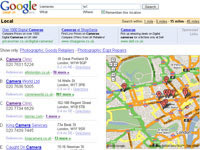
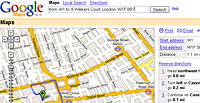 Web search goliaths Google have delivered a large size nine up the rear end of their fierce rivals Yahoo by being the first to launch a local search service in Britain.
 “It’s the first time we’re bringing local search to a country outside North America,” said Kate Burns, ad sales and operations manager for Google in Britain, declining to give details about launches elsewhere in Europe.
 Global search advertising revenue is already sending cash tills into overdrive, with US investment bank Piper Jaffray estimating spending to rise to US$7.9 billion (£4.1BN/€6bn) in 2005 from US$5.5 billion (£4.1bn/€4.2bn) in 2004 – with most of the growth coming from international expansion and higher volume.
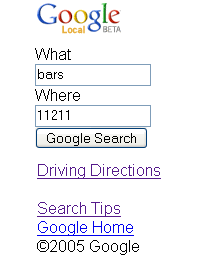 Google is making its local-search service available to mobile-toting users, offering maps and driving directions optimised for the wee screen.
 Telephone numbers are displayed as a hyperlink, and if the users’ phone supports the facility, clicking on the link will dial the listed telephone number (unlike some local search services, there is no additional charge for this).
 Local search services are set to be the big hot potato of 2005, with the Kelsey Group reporting that local search ad spending hit US$162 million (£85m/€125m) in 2004.
 Google has started dishing out factual answers for some queries at the top of its results page, thus sparing click-weary users the hassle of navigating to other sites to look up the information.
 Norvig went on to explain that Google feeds the service with information from Web sites they considers to be reliable, but it’s yet to establish formal relationships with any of the sites providing the content.
 Yahoo’s search engine division has announced that it will be dishing out hardware galore, resources and “critical material aid” to support the non-profit Wikipedia online encyclopedia.
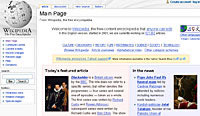 “Their popularity is growing very fast and, accordingly, their bandwidth and hardware needs have increased substantially.”
 The wires are buzzing with rumours that Barry Diller’s InterActive Corp (IAC) is set to buy the Internet search engine service Ask Jeeves for almost $2bn.
 We tried to check the story by visiting Ask Jeeves and typing in, “are you being bought by InterActive Corp?”
 A handy Google search feature went live this week that lets users find showtimes at nearby movie theatres using either their computer or mobile phones and other wireless devices that use short-message services.
 After receiving a sound pummelling in previous rounds against the mighty Google, Microsoft has produced a leaner, meaner more bad-ass search engine – and this one looks like it might go the distance.
 Google has added another product to its long list of extended beta services.
  Two Google stories in a day! They’re testing a new interface for their search engine that they’re calling Google Suggest.