 I like this … Guba
In these times, there are many options available to us when we choose how we want to consume media. Sometimes, however, it’s the oldest choices that are the best: A company called Guba has developed a superb Usenet interface, with which it is possible to download music videos, MP3s as well as TV shows. The ease of use of this terrific application blew me straight out of the water, and I immediately signed up to it. Great service, just what I had been looking for and well worth my $15 (£8.50 or there abouts).
Now where did I park… Guidepoint, a company that make navigation and location soft- and hardware, have released a new product, that allows car owners to track their four-wheeled pride and joy using their mobile phone. Although this technology is cool, you might be wondering what appeal it may have to someone of my age, who, at least in the UK, isn’t legally allowed to drive yet.
Well I’ll tell you why this got me a teensy bit excited: I’m a teenager. Teenagers are forgetful, and as such I am forever losing things. Imagine if I could attach small locator tags to items I lose often, and then find these tags using my mobile phone. This sort of technology would stop me losing anything, ever, and would save me countless hours of looking for my keys when they fall down the back of my desk again.
Here’s another examples. Can’t find my graphics folder for school? No problem, just whip out my mobile phone, and I would get a map with a little cross-hair on, telling me exactly where it’s located. If it was closer than, say, 10 metres, I would instead get a small arrow with a distance reading next to it, which would guide me towards the item that I had lost.
I’m not sure how such a technology would work, but a mixture of a flavour of 802.x and bluetooth would be cool, with maybe some GPS thrown in for the maps. Now if only Father Christmas read Digital-Lifestyles, he might bring me one… Sigh…
By the way, Guidepoint has now expanded their mobile service to include remote car starting and door-unlocking. Could come in handy next time I’m planning a bank robbery ;-)
 Hope it gives change!
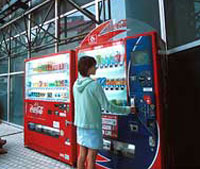
This one just about qualifies as part of the weekly round up. Engadget covered the news that mobile phone giant Vodafone are to start selling mobile phones in vending machines. Interesting idea, but I can’t really imagine it taking off to be honest: When I go phone shopping, I value the expertise of specially trained staff and the advice they have to give.
On the other hand though, a lot of staff in shops seem to lack any knowledge of mobile phones… Maybe it’s just a cost-saving measure, but sometimes I think when I walk into certain phone shops that they might as well be employing monkeys half the time!
Still though, although I personally wouldn’t buy a phone from a vending machine I can see a lot of kids who don’t care what they get as long as it’s a phone buying these.
 This morning, Homechoice, the currently London-focused DSL-based VOD announced that they had appointed CSFB (Credit Suisse First Boston, as was) to raise new capital for their expansion around the UK.
 Their newly-announced ARPU (Average Revenue Per User) figures are impressive at £430, being considerably higher than Sky’s £384 (announced in 3 August 2005), but lower than Telewest’s £538 and ntl’s £477 (reported to ofcom, Q2 2005).
 MacExpo has moved to Olympia from the Islington Design Centre and that’s probably the most exciting bit of the show.
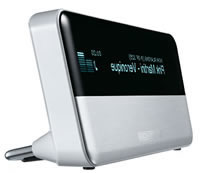 The new G5’s are nice, based on the PCI Express architecture with the ability to put some very high-end NVidia graphics to real work. They now support two CPU’s each with dual cores (i.e. 4 cores) though each core only operates up to 2.5GHz rather than the older two CPU systems that operate up to 2.7GHz (but then, in theory, you’re getting 10GHz compared to a max previously of 3.4GHz – real world tests show more like a 67% speed increase). The new NVidia graphics cards are all capable of driving dual displays – so that’s two 30″ Cinema displays … but you’ll need a new desk.
 The new iMacs were there too and they are still the sexiest systems on the market.
 Vodafone UK and British Sky Broadcasting (Sky) have announced an agreement to launch Sky Mobile TV, the UK’s first commercially available mobile TV service available on a wide range of handsets, as we
  The deal looks set to turbo-boost adoption of entertainment and information services to mobile phones, with users able to enjoy TV programmes on the move with access to live breaking news and sports reports from Sky News and Sky Sports News.
 The Sky Mobile TV pack will be provided free of charge (subject to Vodafone customer fair usage policy) until the end of January 2006, with customers being charged £5.00 (~$8.90, €7.38) per month for each of the Sky Mobile TV packs subscribed to thereafter,
 Additional mobile channels are likely to sign up to the Sky Mobile TV service over the coming months.
 Telefonica SA, Spain’s número uno telecoms company, has agreed to shell out a massive £17.7 billion ($31.5 bn, €21.15bn) for U.K. mobile-phone operator O2, making it the largest acquisition in the European telecommunications industry for half a decade.
 Management execs at the two European telecommunications operators were positively purring at news of the deal.
 O2 was spun off from the BT Group in November 2001 and currently employs 5,000 people.
 BT is planning to turbo-boost broadband connectivity by quadrupling basic connectivity speeds to 8mbps nationwide and giving the service a snappy name, “ADSL Broadband Max”.
 The 8mbps service will see BT reaching the theoretical top ADSL speeds it announced when the broadband service first launched in 2000.
 With the industry rapidly consolidating, BT is coming under increasing pressure from newly merged uber-telecos like Telewest/NTL and Sky/Easynet, with the former already offering speeds of more than 8mbps for no extra charge on existing broadband subscriptions.
 Elsewhere, BT has started trialling optical fibre broadband services in Wales, connecting business to ultra-high-bandwidth services using strands of blown fibre run along using existing telegraph poles.
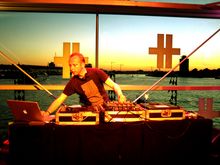 The festival has been developed by Bloc (Creative Technology Wales) and Chapter Arts Centre, Cardiff. They have managed to accommodate a large number of complex yet accessible projects. This collaboration is all the more impressive in its scale when you realise that both organisations have their own projects running concurrently (Bloc are developing Northern and Southern pilot projects in Wales with accompanying seminars; Chapter are hosting the first UK showing o the artists Olaf Breuning).
 To join in you can access a number of computer terminals at the National Museum and Gallery or at one of the festival hubs at Chapter or g39 (cor). If you are unable to visit you can play from your own
  The artist group Second Site will be displaying new video works in the windows of a empty bank on Bute Street, while Chris Evans will project his interactive game onto St John’s Church in the centre of Cardiff.
 Wi-Fly
 Is it a bird, is it a plane…
 Oooh Aaargh, ‘cos we’re pirates!
 Sky have been mulling about an IPTV service for a while. They were in discussions with THUS who provide the telecoms back-end for their SkyTalk service and helped Sky with their WapTV services, they were talking about doing an IPTV trial with THUS, but THUS pulled out of the LLU arena due to lack of cash. They were looking at spending £20m+ on just a trial.
 Sky have got the resources to bolster a depressed telecoms market and put the necessary cash into a company to achieve a reasonable roll-out. Of course they also have the content that consumers want. If another “triple-play” broadband provider wants to get into the game (including BT Retail), Sky can make it very difficult for them by not licensing Sky content (of course Ofcom may force them to, as they have done in the cable industry).
 Sky are also in an odd position as they’ll probably utilise MPEG-4 as the coding system, which means they’ll have to modify (or supplement) their existing transmission systems which are all based on MPEG-2. They’ll also have to introduce a new IP based set-top-box. However they’ll have to be carefull as to not make it too feature rich compared to existing STB’s used to decode the satellite transmissions or existing users will want to migrate to the broadband version – which will cost Sky a huge ammount as the exisitng boxes are considerably subsidised.
 It’s a fact of life – almost everywhere we turn we are surrounded by technology. From mobile phones and digital cameras to TVs and video games. But as well as making our lives easier and providing us with entertainment, more and more artists are now turning to everyday technologies when they create their work.
 “The event will be held at various sites across the capital and will illuminate the city with dynamic and individual work using a range of new and existing technologies,” said festival co-director Emma Posey.
 “We want to create a vibrant creative technology sector in Wales, with the festival celebrating this every two years.”