All the companies designing, specifying and procuring Digital TV Services equipment, including service providers, broadcasters, telecom and internet operators, silicon and software providers, are invited to attend the meeting together with national energy efficiency expert and policy makers. The meeting discussions cover both sophisticate Set Top Boxes for subscriber services over satellite, cable, ADSL and terrestrial, as well as simple digital to analogue converter boxes for free to air digital transmission. The main item on the agenda are the effective implementation and market coverage of the revised EU Code of Conduct on Energy Efficiency in Digital TV Services, with the aim to create a broad and shared consensus by the major players on the Code of Conduct consumption limits and power management guidelines. Joint Research Centre, Ispra (VA) Italy
March 2006
Unlocking the Digital Dividend – Policy Tracker Event
 If you thought the switchover to digital television was going to be a challenge, spare a thought for the regulators, policy makers and engineers who are already tasked with trying to figure out the best way of re-allocating the spectrum freed up by switching off the analogue broadcasting signal.
There are a multitude of possible new uses for the spectrum released by switchover, including re-allocating (or re-gifting) it back to the very broadcasters who previously used it in order for them to deliver HD and other services.
Mobile providers are also launching a campaign to ensure an allocation for mobile TV over DVB-H, or extending 3G and rolling out mobile broadband services. Some countries may even look to allocate the spectrum to defence and/or emergency service uses. Or it could well be a mix of all of the above – although the resource is finite – hence the issue.
It was this re-allocation process that provided the focus for an event run today by Policy Tracker. Unfortunately, I was only able to attend the first couple of sessions – but the roster of speakers for the day looked very strong indeed. I hope that Policy Tracker will look to do more events, if they are of this calibre.
 The first two sessions focused mainly on the problems associated with harmonisation. It is essential that adjoining states will have to work together to allocate spectrum, if there are not to be interference issues. The ITU’s Regional Radiocommunication Conference (RRC-06) which will be held in Geneva between May 15 and June 16, aims to provide the necessary regulatory framework for national regulators such as Ofcom as they look to re-allocate. This framework will not limit or determine the re-allocation but ensure licence holders meet certain requirements to ensure harmonious use – enforced by national regulators.
It was interesting to note that London’s geographical location – and possible interference in parts of France and Holland – will mean that any allocation for DVB-H services will effectively have to wait until 2012. Ofcom have already stated this – but pressure will surely start to mount when other European cities (where there are no associated interference issues) will start rolling out DVB-H mobile TV starting in 2007.
Interesting comments from Roberto Ercole of the GSM Association, who said that mobile providers were currently unsure about how the reallocation process would work. He said that the industry faced three key issues – regulatory uncertainty, not knowing whether mobile TV would come under the same regulations as broadcasting, and the possible fragmentation of markets due to allocations differing across regions.
 Of course regulatory uncertainty is same for all those looking to unlock the digital dividend (although some argue that the broadcasters are well positioned because they already sit on the spectrum). Whatever happens its going to be a complex and highly political interplay between policy makers, regulators and transnational organisations such as the ITU.
There is a very difficult balance to strike, ensuring that there is enough incentive for potential users to keep investing and developing technologies whilst also ensuring that the released spectrum will be used in the most productive and efficient manner.
A particularly pertinent question from one delegate – that didn’t get an answer – what is that citizen/consumers will get from the re-allocation? Afterall it is citizen/consumers who are effectively having to pay to release the spectrum. Ofcom’s initial proposals on the issue suggest that this is a question that they will look to answer – so we’ll wait and see.
M.A.G.I.C Windows Smartphone Has Everything!
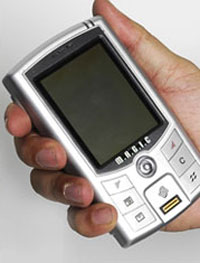
 Currently hovering betwixt prototype and retail status, Advance Tech Communications new Windows Mobile smartphone market looks hot! hot! hot!
The MAGIC (Mobile Advanced Global Integrated Communicator) comes stuffed to the gills with connectivity and multimedia options, and is powered by a beefy Intel Xscale 624 MHz CPU with graphic accelerator 2700G3 and Video RaM – fast enough to leave all current Windows Mobile phones coughing in the dust.
The 10.5 ounce (300 g) Windows Mobile 5.0 device comes with more connections than a street spiv, offering GSM quad band, GPRS, Wi-Fi 802.11b, EDGE, Bluetooth 2.0, IrDA FIR 4 and, of course, USB.
There’s also a built-in Global Positioning System( GPS) and, apparently, a Biometric Sensor.
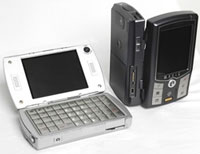
 On board storage is taken care of courtesy of a generous 8GB hard disk, backed up by 512MB RAM and 512MB ROM, with a micro-SD expansion card slot.
There’s two 2.8″ QVGA (320×240 pixels) displays onboard and – you’ve guessed it – there’s also two cameras, both offering a healthy 2 megapixel resolution.
Wrapping up the extensive feature set is a very useful VGA Out port and a small QWERTY keyboard for the tippity-tap action.
With all this functionality crammed in to the phone, it seems that Advance Tech felt that describing the ultra-premium device as a ‘smartphone’ would be like calling a Leica camera a point’n’shooter.
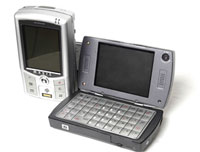
 Instead, the company are proclaiming their new device to be a “laptop computer miniaturised to the size of a handheld device,” which perhaps isn’t the snappiest description they could have come up with.
With its ten-mile long spec sheet, it’s not surprising to find both price and physical size are going to be on the b-i-g side, with the MAGIC measuring up at 125 x 70 x 32 mm and the price hovering around the high end $1,000 mark (£575, €838) .
The MAGIC is expected to roll out next quarter.
Vodafone To Trial High Speed 3G Broadband, All Major UK Cities – News Release
- Customer trials starting in early April ahead of mid 2006launch
- Vodafone UK HSDPA network roll out on track
- All major UK towns and cities to have high speed Vodafone 3Gbroadband by end 2006
Following successful testing in Newbury, Vodafone UK will start customertrials on its live HSDPA (High Speed Downlink Packet Access) network fromApril.
With 100 business users testing Vodafone UK’s HSDPA-enabled Mobile ConnectCards across central and greater London, the trials represent an importantmilestone in the evolution of the company’s 3G network.
Tim Miles, CEO Vodafone UK said: “The start of our high speed 3G broadbandtrial marks our relentless commitment to offering the best possibleexperience to our customers. We have seen high demand for 3G since itslaunch two years ago and our customers are hungry for the improvements thatHSDPA will deliver. These important trials are part of a continuing driveto lead the UK through superior network performance and a customerexperience that is second to none.”
HSDPA will deliver a faster mobile broadband experience to Vodafonecustomers in the UK from mid-2006, initially offering the mobile transfer ofdata from the internet and intranet at roughly four times faster thancurrent 3G speeds. It will also deliver greater capacity (three times thatof current 3G levels) meaning that more people in the same location at thesame time can benefit from a superior experience. In addition, HSDPA offersimproved latency, giving faster access to web-based content. As a result,customers will be able to work faster and download larger documents, such asPowerPoint presentations and email attachments, more quickly.
“HSDPA offers a win-win opportunity for both customers and Vodafone – itdelivers on the promise of 3G to provide broadband-like services whilst onthe move,” comments Michael Ransom, Research Director for Wireless atCurrent Analysis.
He continues: “With higher HSDPA-driven wireless performance, Vodafone willenable business customers to move beyond mobile email and become mobileenterprises.”From mid-2006, Vodafone will phase in the introduction of a high-speedmobile broadband service. Customers within the M25 will be the first tobenefit with coverage rolling out across all major UK towns and cities bythe end of 2006.
Digital Imagine Cup – Be sure not to tell anyone
 On balance, the world is probably a better place with Microsoft, than it would be if Bill Gates hadn’t succeeded. But this week, the company is trying to get us to admit something different: that it is an innovative presence in the world, encouraging innovation in others. Specifically, it is running the Imagine Cup, and this week, in the UK, it’s judging 50 students who have entered a programming competition.
Click on the streaming video link and you’ll see why I’m sceptical about this.
 The content is fine! It goes on fairly meaninglessly with an animated techno-rabbit running around and flying; and then launches the theme.
As you’d expect from Microsoft, the theme is laudable. Praiseworthy, even: it’s “Imagine a world where technology enables us to live healthier lives.” Well, duh… but how about “imagine a world where I can watch the promo without waiting for the buffer to fill up?” or “imagine a world where I can watch the promo without it stopping and starting and re-buffering?” or even “imagine being able to download this promo and send it to a friend”?
Microsoft’s technology for the Imagine Cup promo is a streaming video technology. Look closely at the link: it’s a standard WMV media file, right? Wrong! – it’s actually a link to a WVX file. And instead of being HTTP:// the file is actually MMS:// – which means, quite simply, you can’t download it.
 So naturally, I asked MS why. I got their local expert, and asked: “Why on earth would you copy-protect a promotional video? Surely, the idea is that people mail it around, and it generates viral marketing traction, like the German Coastguard?”
Apparently, the reason it’s not downloadable has nothing to do with copy protection. It’s “because it’s too long,” my expert assured me.
He explained: “We have a policy on web sites, that only short multimedia clips can be downloaded, because of the problems for modem users.”
 As excuses go, that is such clear nonsense that I didn’t know what to say. If you have a modem link, you certainly can’t stream a WMV file. I couldn’t stream it with a 10megabit Telewest cable modem! And in any case, both the clips on that page are short! – one is two minutes, and that’s the long one. The other is 30 seconds.
Also, it’s exactly the opposite of what you want. It’s a long file that you need to download, because the longer the file, the more risk there is of network congestion.
So, in order to save you from the problem in the first place, can I point you at SDP Multimedia? The SDP utility will take the streamed video, and save it onto your disk as a WMV file, and you can then send it off to your friends.
As for the Imagine Cup, you’re too late to apply for the software competition. The UK heat is run on Friday 10th this week in Reading. But you’re free to apply for the short film section, or any of the other categories.
Origami Smart Display
 The London book fair, just finished. At it, there was no sign of an e-book reader from Microsoft – which is odd, because all the stuff Microsoft has been teasing us about with Origami looks exactly the sort of thing that the Book Fair would have got excited about.
Unless, of course, it’s the long-awaited portable XBox? Good question. What is Origami, then?
Origami is another “Smart Display” – but one which imitates the Nokia 770 Internet Tablet. You probably missed the Smart Display, anyway; and the 770 was only really revealed last week, at a Linux show, but both are weird devices.
Smart Display: it was a flat display. But instead of being stuck on your desk, it was portable. You pulled the screen out of the stand, and took it downstairs; it had WiFi inside it, and as soon as it noticed it was mobile, it looked for the host computer.
It was back in late 2003 that Microsoft canned Smart display, and at the time I remember writing: “The problem with it was pretty simple. If you got the small one, it was actually smaller than most Tablet PCs – and no cheaper. If you got the big one, it was really too heavy and clumsy to carry around.” And also, if you took it away from the home WiFi, it died. It was ONLY worth playing with indoors, while the WiFi was working. It had zero function out of range.
Origami is smaller still. But it works out in the open. An ideal device for a portable electronic book reader? We’ll find out tomorrow if the hardware is up to it, and one key question will be “can you read it in sunlight?” – but the real reason to be sceptical is “What will be available to read on it?”
That’s where Microsoft loses out. Sony’s Librié may be disappointing, but it will (I promise!) have ten times the battery life of Origami, be readable in bright sun, and easier to read generally. And even if none of that was true, it would still win, because Sony has done an iPod on it, and signed up all the book publishers.
Microsoft can’t do that, because it isn’t making Origami. It has designed it; people like Samsung will actually make it.
So Origami isn’t an e-book reader. It’s not a pocket PC either, and it’s not a phone. It’s a light-weight Smart Display, with a “go anywhere” wireless. Who wants it?
Clue from PopCap Games. Bejeweled 2, Zuma, Bookworm. Is this, finally, the answer to the Playstation Portable by Microsoft?
DCT-DPM1 World’s First Dual Pointer Mouse
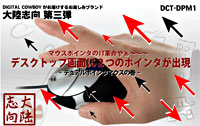
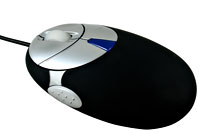
 Thanks to innovative manufacturers like Logitech, we’ve had mice (mouses?) with more buttons than a Cinderella reunion, but just when you thought that the humble mouse couldn’t get any more new features, Digital Cowboy have announced the world’s first dual pointer mouse, the DCT-DPM1.
It looks like an ordinary mouse but has an unusual trick up its sleeve – when you activate the button on the left hand side of the mouse a second cursor appears on screen!
Now, this may sound like something developed by the Ministry of Bonkers Ideas on their annual ‘Let’s Take Acid’ day, but there might just be a method to their madness.
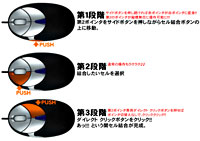
 The DCT-DPM1 is aimed at people with multiple desktop displays, where users currently have to scroll across hefty distances when they jump from screen to screen.
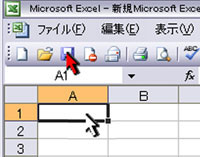
With the new double cursor mouse, you can ‘park’ the first cursor on a point on the one screen, and then work on the other screen as usual.
 Flipping between the two work areas is then simply a case of activating the mouse button to access the ‘parked’ cursor, without any need for a marathon of cross-screen scrolling.
And if you’re constantly having to input text into two different areas, the dual cursor idea could also be a winner, although we’re not sure if our limited brains could cope with two cursors on the go.
 We’ve no idea when, or even if, this bi-cursorary device will be making it to the UK, but it is possible we could be witnessing the next evolution of the mouse.
Either that or it’s another really crap idea.
Mouse specs:Product name: DCT-DPM1 (JAN:4543183505031)
Colour: Black
The number of pointers: 2
The number of mouse buttons: 5 (the scroll button is included)
Resolution: 800dpi
Interface: USB & PS/2 (at the time of attachment adapter use)
OS: WindowsXp/2000
Size: Approximately 107×55×29mm
Cable length: 150cm
Accessory:USB -> PS/2 conversion adapter
Driver: CDNokia Launches Lifeblog 2.0
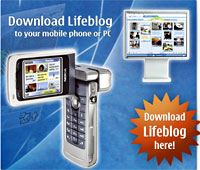
Nokia has launched Nokia Lifeblog 2.0, an updated version of their photo-blogging offering.Designed for Nokia’s Nseries handsets, Lifeblog lets users create a multimedia diary, with photos, video clips, messages and text notes and store them on their phone and/or PCs.
The material is presented in a chronological manner, with the new version of Lifeblog offering the ability to add audio notes, calendar entries and location information, so that users can add some context to their pictures and video clips.
 Well, that’s how we’d describe the process, but Nokia has a more flowery interpretation, insisting that adding the extra information is “rendering them as part of the rich tapestry of items that make up your personal Nokia Lifeblog timeline.”
The new Nokia Lifeblog can be set up to link photos to information about a user’s location, the time or calendar entries, so that any photos taken at, say, a wedding, would automatically be tagged with this information from the user’s calendar.
 “With imaging becoming an integral part of mobile devices, the way people approach photography is changing. You are able to capture events and create memories in a spontaneous way as your device is always with you,” gushed Mikko Pilkama, whose job title is surely unpronounceable after five beers: Director, Nokia Nseries See New, Multimedia, Nokia.
Content from the NSeries phones can be transferred to a compatible PC, and photos and video clips can also be shared directly from PCs via email or by blogging to a compatible service.
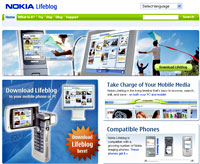
The PC version of the software lets users import existing digital photo collection from their hard drive to their phone – this software can be downloaded for free from www.nokia.com/lifeblog.
Bypass Automated Phone Operators With Gethuman!
 “Press one if you’re a
 customer, press two if there’s an ‘R’ in the month, press three if you want , press four …” Are you fed up having to press endless key combinations at the behest of a recorded voice every time you ring your bank?
Have you had enough of dealing with automated responses when all you want to do is talk to a phreaking human about your problem?
Then help is at hand, thanks to the wonderful folks at gethuman.com.
Started by Paul English to “change the face of customer service in the US”, the site offers wealth of keyboard combinations to bypass squawking, beeping auto-bot operators and get straight to a living, breathing human being.
The non-profit site features long lists of cunning keypad combinations that let users get off the automated phone merry-go-round and straight to the ear of a human operator.
Happily, as well as a large US database, there’s a growing list of UK companies, including banks, building societies, finance companies, mobile companies and more.
Here’s some example entries from the ‘gethuman’ UK database – obviously, we haven’t tested them all, but initial reports have been encouraging, but tell us how you got on.American Express 01273 576576
Press # at each prompt.Barclaycard 0870 1540154
Keep pressing 0 when asked for your 16 digit number.NatWest Gold Card 0870 3331993
Don’t press anything. (Ignore 4 prompts.)After two failures, press 2 for an account manager.Orange 07973 100450
Press 0# each time you are prompted for a number (3 times)T mobile UK 0845 4125000
Press 0 at each of the first 3 prompts.The gethuman.com database being constantly updated, revised and expanded and also features some helpful tips and tricks, with a blog offering insights and info, so it’s worth keeping an eye on it to see if your bank turns up on their list.
Bookmarked!
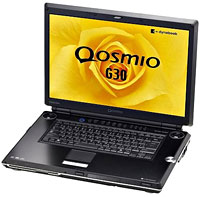
Toshiba Announce M100 Series And Qosmio G30 HD-DVD Laptops
 Toshiba is rolling out its first Satellite models with Intel Core Duo and Core Solo processors.
The new M100 series includes a 14.1-inch display, CD, DVD or DVD SuperMulti Double Layer drive, hard drives running from 40GB to 120GB, maximum memory of 2GB, WiFi and a 5-in-1 memory card reader.
A handy Express Media Player lets users access DVDs or CDs without the palaver of booting up Windows.
 The notebooks include Intel’s 945 Express chipset employing Intel Centrino Mobile Technology to reduce power consumption while and give a kick up the backside of the laptop’s graphics to wireless performance.
Running on a choice of XP Home or Pro and fitted with 256MB to 2048MB of RAM , the new Satellite M100 comes in three colours, all with silly names: Peacock, Mist Gray and Sunlight Copper.
Satellite M100 Example Configuration:
Processor: Intel Centrino Duo Mobile Technology featuring the Intel Core(TM) Duo Processor(a) T2300 (Dual 1.83 GHz, 667 MHz FSB, 2MB L2 cache)
Display: 14-inch diagonal widescreen TruBrite(TM) TFT active-matrix LCD display WXGA with 1280×768 native resolution
System Chipset: Mobile Intel 945PM Express Chipset
Graphics Controller: Intel Graphics Media Accelerator 950
Memory: 512MB (2x256MB) DDR2 SDRAM memory
Hard Drive: 60GB (5400 rpm) Serial-ATA (SATA) hard disk drive
Optical Drive: DVD SuperMulti Double Layer drive supporting +R and -R double layer formats
Wireless: Integrated Intel Pro/Wireless Network Connection 3945ABG (802.11a/b/g)
Ports: 4 USB 2.0, TV-Out (S-Video), RGB, RJ-11 modem (v.92), RJ-45 LAN, headphone and microphone ports
Slots: 5-in-1 Bridge Media Adapter (Secure Digital(R), Memory Stick(TM), Memory Stick PRO(TM), Multi Media Card, xD Picture Card); PCMCIA PC Card slot
Audio: harman/kardon(R) stereo speakers
Battery: 6-cell (4700mAh) Lithium Ion
Operating System: Microsoft Windows XP Home Edition 2005
Dimensions: 13.5- x 9.53- x 1.5-inch
Weight: Starting at 5.20 lbsQosmio G30 HD-DVD laptop
Toshiba have also announced their first laptop computer with an HD-DVD drive, due to be launched in April. The Qosmio G30 is part is of Toshiba’s multimedia PC line and will come with a TV tuner and Dolby Home Theatre support.
Costing from $2,410 upwards, users will be able to watch HD-DVD content on the laptop’s screen or hook it up to a compatible high-definition monitor or television via a HDMI (high-definition multimedia interface).
HD-DVD is currently doing battle with Blu-Ray to become the de facto standard for high-definition content such as movies.
 Backed by Toshiba and NEC, it faces heavy competition from the Blu-Ray corner, whose hard-hitting supporters include Sony, Matsushita, Panasonic and Samsung.
Although HD-DVD will initially only be offered in Toshiba’s expensive Qosmio notebook range, the company some models in the cheaper Satellite line may offer HD-DVD by the end of 2006.
Background to HD-DVD/Blu-Ray battle:
Paramount To Offer HD-DVD and Blu-ray Disc Movies (Oct 2005)
Unified DVD Format On Rocks (Aug 2005)
Sony, Toshiba May Create Universal Blu-Ray/HD DVD Standard (Apr 2005)
 If you thought the switchover to digital television was going to be a challenge, spare a thought for the regulators, policy makers and engineers who are already tasked with trying to figure out the best way of re-allocating the spectrum freed up by switching off the analogue broadcasting signal.
 The first two sessions focused mainly on the problems associated with harmonisation. It is essential that adjoining states will have to work together to allocate spectrum, if there are not to be interference issues. The ITU’s
  Of course regulatory uncertainty is same for all those looking to unlock the digital dividend (although some argue that the broadcasters are well positioned because they already sit on the spectrum). Whatever happens its going to be a complex and highly political interplay between policy makers, regulators and transnational organisations such as the ITU.
 Luke Gibbs is a co-founder of
  Currently hovering betwixt prototype and retail status, Advance Tech Communications new Windows Mobile smartphone market looks hot! hot! hot!
 On board storage is taken care of courtesy of a generous 8GB hard disk, backed up by 512MB RAM and 512MB ROM, with a micro-SD expansion card slot.
 Instead, the company are proclaiming their new device to be a “laptop computer miniaturised to the size of a handheld device,” which perhaps isn’t the snappiest description they could have come up with.
 On balance, the world is probably a better place with Microsoft, than it would be if Bill Gates hadn’t succeeded. But this week, the company is trying to get us to admit something different: that it is an innovative presence in the world, encouraging innovation in others. Specifically, it is running the Imagine Cup, and this week, in the UK, it’s judging 50 students who have entered a programming competition.
 The content is fine! It goes on fairly meaninglessly with an animated techno-rabbit running around and flying; and then launches the theme.
 So naturally, I asked MS why. I got their local expert, and asked: “Why on earth would you copy-protect a promotional video? Surely, the idea is that people mail it around, and it generates viral marketing traction, like the
  As excuses go, that is such clear nonsense that I didn’t know what to say. If you have a modem link, you certainly can’t stream a WMV file. I couldn’t stream it with a 10megabit Telewest cable modem! And in any case, both the clips on that page are short! – one is two minutes, and that’s the long one. The other is 30 seconds.
 The London book fair, just finished. At it, there was no sign of an e-book reader from Microsoft – which is odd, because all the stuff Microsoft has been teasing us about with
  Thanks to innovative manufacturers like Logitech, we’ve had mice (mouses?) with more buttons than a Cinderella reunion, but just when you thought that the humble mouse couldn’t get any more new features, Digital Cowboy have announced the world’s first dual pointer mouse, the DCT-DPM1.
 The DCT-DPM1 is aimed at people with multiple desktop displays, where users currently have to scroll across hefty distances when they jump from screen to screen.
 Flipping between the two work areas is then simply a case of activating the mouse button to access the ‘parked’ cursor, without any need for a marathon of cross-screen scrolling.
 We’ve no idea when, or even if, this bi-cursorary device will be making it to the UK, but it is possible we could be witnessing the next evolution of the mouse.
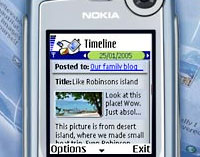 Nokia has launched Nokia Lifeblog 2.0, an updated version of their photo-blogging offering.
 Well, that’s how we’d describe the process, but Nokia has a more flowery interpretation, insisting that adding the extra information is “rendering them as part of the rich tapestry of items that make up your personal Nokia Lifeblog timeline.”
 “With imaging becoming an integral part of mobile devices, the way people approach photography is changing. You are able to capture events and create memories in a spontaneous way as your device is always with you,” gushed Mikko Pilkama, whose job title is surely unpronounceable after five beers: Director, Nokia Nseries See New, Multimedia, Nokia.
 “Press one if you’re a
 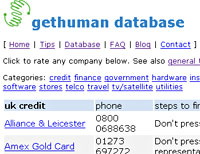 Here’s some example entries from the ‘gethuman’ UK database – obviously, we haven’t tested them all, but initial reports have been encouraging, but tell us how you got on.
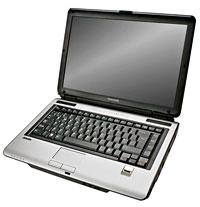 Toshiba is rolling out its first Satellite models with Intel Core Duo and Core Solo processors.
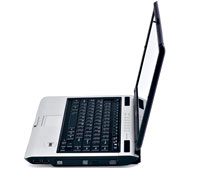 The notebooks include Intel’s 945 Express chipset employing Intel Centrino Mobile Technology to reduce power consumption while and give a kick up the backside of the laptop’s graphics to wireless performance.
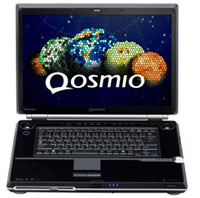 The Qosmio G30 is part is of Toshiba’s multimedia PC line and will come with a TV tuner and Dolby Home Theatre support.
 Backed by Toshiba and NEC, it faces heavy competition from the Blu-Ray corner, whose hard-hitting supporters include Sony, Matsushita, Panasonic and Samsung.