 It’s hardly revelatory stuff, but a study by J.D. Power and Associates has revealed that customer service issues dealt with by living, breathing human beings create significantly higher customer care ratings than those with computer-generated interaction.
The 2005 Wireless Customer Care Performance Study, now in its third year, examines customer experiences in three point-of-contact methods: on the blower with a service representative and/or automated response system (ARS); walk-in at a retail store; and online Internet connection.
The men in the white lab coats examined processing issues such as problem resolution efficiency and the time customers were left listening to cheesy on-hold music and drew up a customer satisfaction index.
Customers dealing with service representatives over the phone registered an average index score of 109, well above the industry average score of 100.
At the retail store, things weren’t quite so positive, but still returned an above-average score of 102.
However, when it came to customers contacting their carrier with a problem and being left to deal with a gibbering box of wires in an ARS system, the index score plummeted down to 85.
Trying to get an answer online proved to be even more frustrating, with the index score plunging down to just 75.
The study reveals that customers didn’t like the inflexibility of automated systems, noting that a service representative-either over the phone or in person-can answer customer questions and clarify answers given.
Not surprisingly, this compares favourably to spending an eternity on the phone being told to endlessly bash different numbers on a keypad.
 “As more companies encourage customers to contact Internet and computer-based customer service programs to save operating costs, they run the risk of increasing churn [techie word for a customer switching carriers] as the number of contacts needed to resolve a customer complaint or issue rises,” said Kirk Parsons, senior director of wireless services at J.D. Power and Associates.
“Since future churn levels are four times as high among those who rate their wireless carrier below average in customer care, the challenge for wireless providers is to offer an easy and efficient customer care transaction experience.”
Contrary to my personal experience, T-Mobile US ranked highest among the six big-boy wireless service providers in “creating a positive experience among customers who contact their providers for service or assistance.”
Victorious for the second consecutive year, T-Mobile notched up an index score of 108, and was seen as performing particularly well across all factors, especially hold-time duration and problem resolution efficiency.
Additionally, T-Mobile customers’ average hold times before waiting to speak with a service representative were an impressive 34 percent less than the industry average (2.27 minutes versus 3.44 minutes).
Verizon Wireless, Nextel and ALLTEL were also noted as performing at or above the industry average.
The study also found that more 54% of wireless users have contacted the customer service department for assistance within the past year – up slightly from last year’s 52%.
Most customers prefer to contact their carriers via the telephone (71%), with 26% using email and only 3% using e-mail/Internet contacts.
The 2005 Wireless Customer Care Performance Study was based on responses from more than 8,600 wireless users who had contacted customer care over the past year.
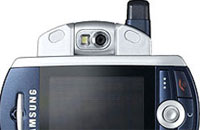
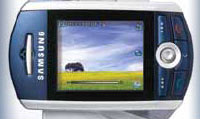 Scheduled for release at the beginning of July is Samsung’s “Web friendly” SGH-Z130 3G handset.
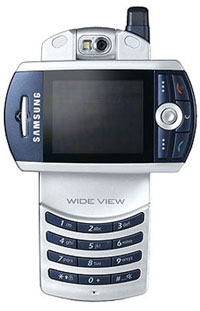 There’s a fair bit of memory on board to handle all the multimedia fluff, with a total of 88.5 MB storage offering 80 MB for Image/Sound/Video, 4 MB for Java, 3 MB for Email and 1.5 MB for MMS with just enough room left over for 200 SMS messages.
 As with earlier versions of Netfront, there is a handy option to render Web pages to fit smaller screen widths, saving a ton of pesky horizontal scrolling.
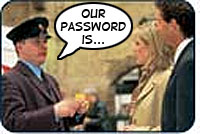 Hot on the heels of yesterday’s story about the ‘world’s greatest military hacker’ comes this tale of advanced doltery from train operator Great North Eastern Railway (GNER), who managed to publish their system passwords in a magazine available to thousands of passengers.
 GNER, owned by the Sea Containers Group, provide high-speed intercity train services along Britain’s East Coast main line, linking England and Scotland along a route of almost 1,000 miles.
 A new survey published today reveals that more Europeans than Americans possessed a broadband Internet connection in the first quarter of 2005, with hi-tech South Korea in danger of losing its global pole position.
 Leading the European charge were countries such as the Netherlands and Denmark whose broadband connectivity now only trails South Korea by a smidgen.
 “Given the slow growth of South Korea, we expect that the top position, now held by South Korea, will change hands this year,” observed TelecomPaper director Ed Achterberg.
 Wi-fi enabled North Londoners can now gorge their connectivity needs with the announcement by Islington Council that its ‘Technology Mile’ has gone live.
 The council are anticipating that locals may use the free access to pay off council bills and are hopeful that the service may stimulate commercial activity in the area.
 An unemployed Scottish man alleged to have carried out “the biggest military computer hack of all time” will appear in a London court today.
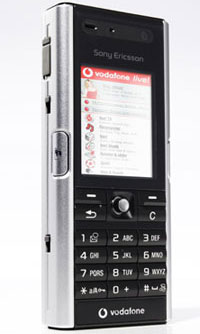 Rather immodestly self-declared as ‘beautifully designed’, Sony Ericsson and Vodafone have announced their new V600i 3G phone.
 Subscribers can also take advantage of the content streamed from the Vodafone live! site, including live sports and music videos.
 Cutting edge office hipsters keen to perfect that
  NTL’s claim that 300K broadband offer was “more than 5 times faster than standard 56K dial-up internet” has been happy-slapped down by the Advertising Standards Authority (ASA), who condemned it as being in breach of TV Advertising Standards Code.
 The telecoms giant insisted that it was standard industry practice to refer to the speed of broadband only in terms of download speed and, to back up their case, readily snitched on a host of competitors making similar claims.
 After an eternity of “will they? won’t they?” rumours Siemens has announced that it is to flog its loss-making mobile-phones unit to the Taiwan-based BenQ Group.
 Through the haze of a soft focus lens, Klaus Kleinfeld, the CEO of Siemens AG whispered sweet nothings about his new bedfellow:
 Perhaps a little tipsy from wielding his fearsome buying power, BenQ Chairman & CEO K.Y. Lee roared “With the acquisition of Siemens’s mobile phones business, we are rapidly approaching our goal to become one of the world’s leading players in the mobile phone industry. Our expansion strategy will be strongly supported by this deal, as we can rely on a global organization with excellent employees, a well-established blue-chip customer base in the mobile business and a strong brand with high impact.”
 “Siemens will continue to offer its customers in the telecommunications industry one-stop shopping for all their needs. With BenQ, we have found a partner who will supply us with the corresponding products. In addition, we will be collaborating closely in research and development. Moreover, we also intend to utilize synergies in jointly addressing customers and in our selling operations,” commented Lothar Pauly, the CEO of the Siemens Communications Group.
 America Online is taking on the likes of Yahoo, Hotmail and Google’s Gmail with its new free 2GB email service in the US, launched yesterday after trials earlier this year.
 Users will be able to log in with their existing AOL IM screen name as their e-mail address, with an updated version of the AIM 5.9 software offering one-click access to AIM Mail.
 The new free service represents a hefty shift in AOL’s business strategy which has traditional involved charging users subscription fees for its services. Instead, the company is expecting to generate revenue from AIM Mail through banner ads – hence the punter-tempting monster giveaway promotion.