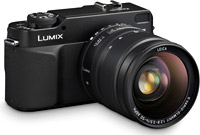
 Panasonic’s first digital SLR camera with interchangeable lens has been announced at the PMA show.
The DMC-L1 utilises Olympus’s Four Thirds System and employs an attractive, solid, traditional design that could prove mighty tempting to old school photographers fed up with fiddly dials and rummaging through onscreen menus.
Coupled with the new Leica D Vario-Elmarit 14-50mm/F2.8-3.5 lens (also announced yesterday), the DMC-L1 serves up a tempting array of hands-on controls, with a large shutter speed dial on the camera’s top plate and manual aperture, focus and zoom ring controls (as well as built-in image stabilisation) on the lens.
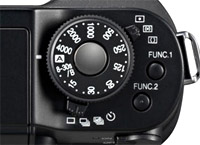 Do we like the sound of that? You betcha!
The 7.5 megapixel camera uses a new Live 4/3 MOS sensor using Panasonic’s Maicovicon technology, which claims to deliver “the beautiful images of a CCD sensor with delicate gradation and a wide dynamic range,” along with low noise and power consumption.
The camera’s innovative mirror box unit offers a Live View function that lets users preview scenes directly on the 2.5inch, high resolution, 207,000 pixel LCD as well as through the viewfinder.
This function can be selected in both Auto Focus and Manual Focus modes, so snappers can enlarge part of an onscreen image to fine tune a picture, with the option to also check the depth of field. Nice.
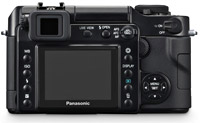 Onboard is Panasonic’s Venus Engine III image processing LSI, claimed to consume only 80% as much power as its predecessor, the Venus Engine II.
The camera also utilises Olympus’s excellent Supersonic Wave Filter which uses high frequencies to blast pesky dust off the camera’s sensor – a real Godsend for photographers fed up with seeing thumping great blotches all over their masterpieces.
The beautifully finished DMC-L1 uses the SD Memory Card format and includes compatibility for the upcoming super-high-capacity 2GB+ SD Memory Cards.
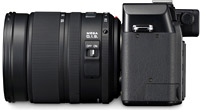 Although full details have yet to be announced, the camera does seem to share quite a bit in common with the Olympus E-330 EVOLT, although the new, Leica-branded lens looks to be a very classy number indeed.
Pricing is yet to be revealed although we suspect your wallet isn’t going to like it one bit.
 Google has struck up a partnership with the US National Archives to digitise their historic movie collection and provide free access to the public through their video search service.
 “Our new strategic plan emphasises the importance of providing access to records anytime, anywhere. This is one of many initiatives that we are launching to make our goal a reality,” he added.
 Happily, this was not the case, as a Google spokesperson explained: “Video uploaders, using Google Video’s ‘Advanced Options’ feature, can choose to blacklist countries. In this case the uploader blacklisted the US and only the US. When uploading the video the content owner set a preference not to show this content to users in the US.”
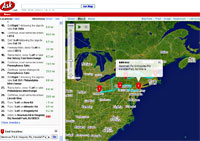 The site formerly known as Ask Jeeves has retired its long serving butler, rebranded itself as ‘Ask.com’ and served up a new, simplified homepage offering access to new tools like enhanced maps, driving directions, encyclopaedia search and a Web-based desktop search.
 Aerial photos can also be overlaid or combined with regular street views, with the option to print aerial shots for a fee.
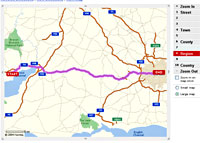 Here’s an idea Ask.com – how about you include a help file to explain this to users, or, even better, give us the same goodies too?
 Old Danny boy’s got his work cut out for him as Ask Jeeves has remained the least used among the largest search engines, way behind market leaders Google who currently hog an estimated 40 per cent of all queries.
 The idea behind buzz-o-phone is simple enough. You call a US freephone (800) number where you’re able to leave a voice message. Your elicitation, wise or otherwise, is the posted to the player section of the buzz-o-phone Web site, where the world can listen.
 We’d imagine that two versions of the ‘conversation’ will have to be created; the raw, which would be an unfiltered version; and the clear-feed, dropping off comments that are judged as offensive. This is riddled with difficulties of its own – as with all censorship, you have to make you’re own decision as to if your parameters of acceptability align with the self-appointed censor.
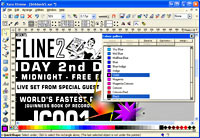 Xara has been around for over a decade now, and although it may not be as well known as expensive rival programs like Illustrator and Freehand, it continues to offer astonishing value for money, providing ample power under the hood and enough tools to satisfy anything from graphic smudgers to arty pros.
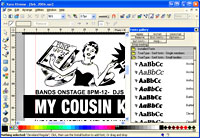
 Although it isn’t the most modern-looking of programs, Xara’s sheer simplicity and power makes it a far less daunting program to master compared to many high-end vector programs, with new users guided by a set of excellent help files and 80+ short movie tutorials.
 Imported images can be resized, have text added and then exported as JPEGs with control over compression settings.
 The verdict
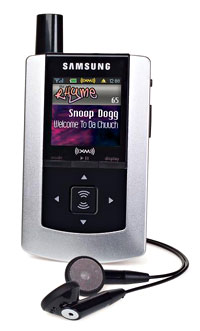 Announced at the CES 2006 show earlier this month, the Samsung Helix XM2Go has now appeared for pre-orders on Amazon.com (US).
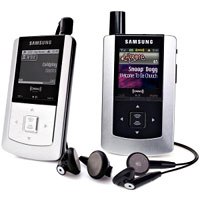 The good news is that the service is commercial free – the bad news is that it’s a subscription service, with plans starting at $12.95 a week.
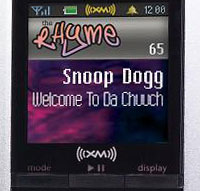 This lets users ‘tag’ a song they hear on the XM radio, and then buy and download the tune song via Napster.
 America Online is about to come out of its corner fighting as it gets ready to slug it out with Internet heavyweights such as MySpace, Skype and Google.
 Mashing up MySpace
 Stalking Skype
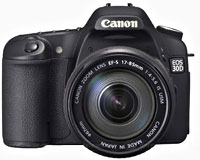 Canon have unleashed a veritable avalanche of new cameras today, with no less than ten new models being announced ahead of the PMA 2006 show.
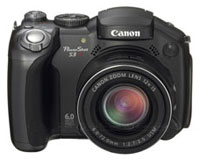 Canon PowerShot S3 IS
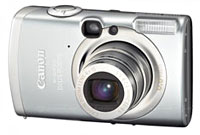 Canon PowerShot SD700 IS Digital ELPH (European name: IXUS 800 IS)
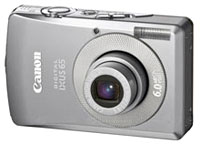 Canon PowerShot SD600 and SD630 (European name: Canon Digital IXUS 60 / IXUS 65)
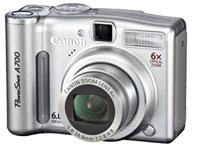 Canon Powershots A700 and A540
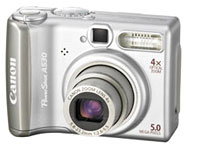 The 4-megapixel A420 serves up a 3.2x zoom and 5-point AiAF auto focus, the 4-megapixel A430 has a 4x optical zoom and 9-point AiAF auto focus while the A530 ramps up the resolution to 5 million pixels, a 4x zoom and ISO 800.