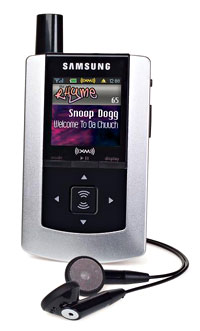
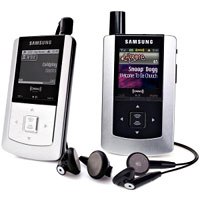
 Announced at the CES 2006 show earlier this month, the Samsung Helix XM2Go has now appeared for pre-orders on Amazon.com (US).
There’s been quite a lot of excitement about the Helix, which comes with an alluring feature set, offering a portable satellite receiver and mp3 player/recorder in a highly pocketable package.
The big news about this unit is its ability to receive XM satellite radio transmissions, letting users combine live XM radio with their personal digital music collections (MP3s and WMA).
XM Satellite Radio may not mean a lot over here in Europe-land, but in America it’s the country’s most popular satellite radio service, offering 160 digital channels, including news, sports, talk and entertainment, traffic & weather with “the deepest playlist in the industry” covering over 2 million titles.
 The good news is that the service is commercial free – the bad news is that it’s a subscription service, with plans starting at $12.95 a week.
The Samsung Helix XM2Go lets users record up to 50 hours of broadcast on its built-in flash memory, with users able to build their own playlists on the device, mixing XM radio content with their own digital music.
A handy built-in memory buffer lets listeners save an entire XM radio song even after the song has already played halfway through, and a built-in FM transmitter means that music can be beamed to any FM radio frequency, making it easy to listen to XM content on any home or car stereos.
The Helix offers a neat TuneSelect feature, which alerts users when one of their favourite artists or songs is being played on an XM channel and there’s also built-in support for the XM + Napster music service.
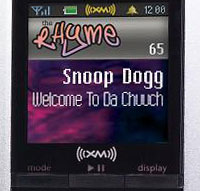 This lets users ‘tag’ a song they hear on the XM radio, and then buy and download the tune song via Napster.
The attractive looking device measures a cutesy 3.7 x 2.2 x 0.6 inches, weighs in at a lightweight 4.5 ounces, with a large 2.2 inch 180 x 180 TFT colour screen dominating the front of the unit.
It’s not cheap at $399.99, (~e335, ~£229) but that’s the sort of price early adopters can expect to pay for such a cutting edge gizmo.
Shipping is expected in early April, with the optional YA-CP100 car kit retailing for $69.99 (~e58, ~£40).
 In an interesting and innovative twist, Dixons have teamed up with Pulse Rated, a Internet radio station, to fill up the empty space on new MP3 players with tracks from unsigned bands.
 We expect this initiative to increase our already impressive tally of artists offered recording deals as a result of our activities – all of which are provided totally free of charge to the artists,” he added with a plug-tastic air.
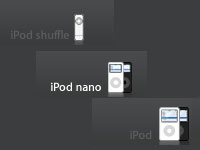
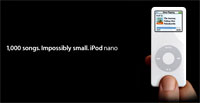
 Keen to further expand their vice-like grip on the portable digital music market, Apple have unveiled a cut-down 1GB version of their turbo box-shifting iPod Nano player.
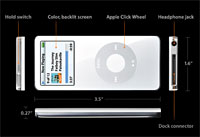 The new 1GB Nano can hold up to 240 songs or 15,000 photographs and comes with all the usual Nano features, including the colour display and docking connector.
 As Shaw Wu, an analyst with American Technology Research, put it: “Apple is selling a $69 MP3 player with the best software. How do you compete with that? It’s tough.”
 The iPod range continues to be an outrageously successful money spinner for Apple, with around 32 million iPods shifted last year, including 14 million during the holiday season.
 Apple have announced a competition to become the downloader of the 1 Billion th music track on iTMS.
 At the time of writing, we see on the live track count that they’ve sold just short of 950,981,000 tracks.
 You know we like to save you money when we can and for those with sharp eyes, you’ll see near at the bottom of the page in light grey (thanks Apple), “*No purchase necessary to win. Click here to submit a free entry form.” Following the link takes you to the form telling that you can indeed make up to 25 free entries a day. We’re not sure on the US rules for competitions, but we know in the UK that free entry is essential when there’s no skill involved with entering the competition.
 Now holding the record for the fastest-selling debut album in the UK, the success of young British indie-rockers Arctic Monkeys shows how the Web has changed both the way in which bands promote and market themselves and how people find new music.
 For less than the cost of a handful of flyers, bands can set up their own Websites, offer free downloadable tunes, sell merchandise, maintain free email mailing lists and invite a dialogue with their fans.
 With a growing fanbase clambering for more, it wasn’t long before record companies were begging to sign up the band, and last week’s album release on Domino Records saw the Artic Monkeys record-breaking leap up the charts.
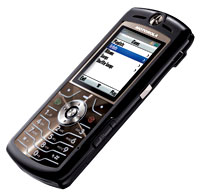 Four months after releasing their first iTunes-enabled mobile phone, the disappointing Motorola ROKR E1, Motorola have had another stab at creating the perfect music phone.
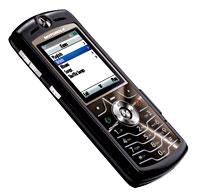 The biggest complaint was the laughably feeble memory on the ROKR that could only hold a maximum of 100 iTunes songs – regardless of memory capacity – and a treacle-slow song transfer rate.
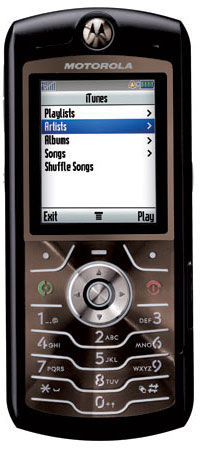 In a flurry of arty waffle, Steve Lalla, vice president and general manager for mass-market products at Motorola, explained that the, “L7 is really in what we call our ‘self-expression portfolio,’ where design and style is the key premise behind the product”.
 Looking for new sources of revenue beyond their Internet telephony service, Skype have announced a deal with Warner Music Group to flog ring tones and artist images.
 “We are excited that more than 70m Skype users around the world will now have the ability to enjoy content from Warner Music artists,” said Alex Zubillaga, executive vice-president in charge of digital strategy and business development at Warner Music (that’s some job title – we wonder if he meets people saying, “Hi, I’m Alex Zubillaga, EVPICODSABD at Warners?”)
 Ringtone sales have proved a surprise hit for mobile operators and content providers, coining in an astonishing $4bn in worldwide sales in 2004 – around 10 per cent of the $32.2bn worldwide music market.
 News has broken that two men in the UK have been found liable for file sharing their music. The first ruling of its kind in the UK.
 Having been found liable, the two are now exposed to the BPI’s legal fees. Given the City law firms the BPI use, where it’s not unusual to pay £200/hours for their services, it’s going to be an expensive business. BPI have stated that “Total costs are estimated at £13,500 and damages are expected to take the bill even higher.”
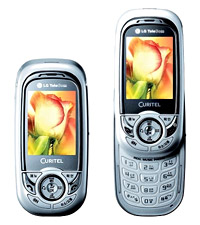 Despite being billed as the “Killer-Sound Phone” by makers Pantech & Curitel, we’re happy to report that the PT-L1900 doesn’t emit a murderous noise beam, but is in fact a top notch music phone.
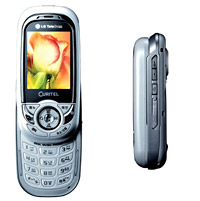 Back to the phone, the mid-size device (102X48X25.7mm) is dominated by a large, two inch, 240X320 pixels (QVGA), 262k colour TFT LCD display screen, with a slide out keyboard for phone functions.
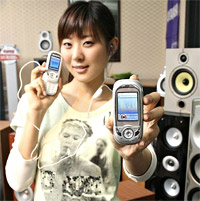 The makers claim up to 190 hours of standby time and up to 3½ hours of talk time.