 America Online has announced a consumer VoIP application, Wanadoo joins the party. The AOL offering will go head-to-head with traditional telephone companies, cable firms and a multitude of start-ups competing for the mainstream-bound VoIP market.
AOL CEO Jonathan Miller announced the decision at VON Spring 2005 trade show, “Within the next month, AOL will launch an Internet phone product, and we believe it will be a truly differentiated product. The initial launch targets specific markets and AOL users.”
Miller added, “Consumers just want something that is reliable and easy to use. Over 60 percent of consumers don’t know what VoIP is or don’t understand what it is, but it is possible they could be sold on it.”
“AOL aims to closely integrate the VoIP service with AOL’s popular email and IM service to create a sort of “communications dashboard. “It will become the centrepiece of the way consumers handle their communications online”, beamed Miller.
The company’s customers will continue to use their traditional phones, but will plug them into adapters connected to their broadband source rather than the socket provided by the telephone company.
 The AOL product will also allow customers to turn IM sessions into phone calls when one of the parties enters the phrase “Can I Call?”
At this point the AOL product will “almost instantaneously” switch the communications session to a VOIP call if the user on the other end is “present.”
To provide the VoIP service, AOL are teaming up with Level 3 Communications who will provide the infrastructure needed to comply with federal 911 and number portability requirements and Sonus Networks who will be responsible for the softswitching.
The company is yet to divulge pricing details for its US service or timetable roll outs in international markets.
Wanadoo
Meanwhile, the stampede for ISPs to reinvent themselves as telcos continues with the French Telecom-owned Wanadoo announcing a new voice over broadband service last week.
For £4 a month, Wanadoo’s broadband customers can get a slice of the free phone call action to other UK landlines during evenings and weekends.
The ISP maintains that the cost of other calls made using its “Wanadoo Wireless and Talk” service are cheaper than BT, while calls to other “Wanadoo Wireless and Talk” punters will cost customers jack diddly squat.
The new service uses Wanadoo’s “Livebox” wireless box to route calls over broadband. Wanadoo’s broadband telephony service is designed as a secondary phone line service for now, but the ISP is hatching cunning plans for it to replace a household’s primary phone line.
Wanadoo UK’s chief exec, Eric Abensur, was on hand to give it the big one, boasting that his company was at the “cutting edge of this fantastic technology”.
He went on to say, “As broadband becomes a standard feature in UK homes – like turning on a tap it will become second nature to use it for all types of services – such as plugging a phone or two into your home network or watching TV, and we look forward to making further exciting announcements over the coming months.”
Wanadoo’s VoIP service launched in France last year, but was riddled with so many bugs that almost 300 Wanadoo staff in France went on strike before Christmas in protest at having to deal with extra-stroppy customers complaining that the service didn’t work.
However, a spokeswoman for Wanadoo UK said that call centre staff in the UK had been fully trained to support the product. “We’d only launch a product that we have confidence in,” she said.
 ATI Technologies have introduced two new media processors, IMAGEON 2282 and IMAGEON 2182, offering a shovel load of ‘groundbreaking’ multimedia capabilities for mobile phones.
 “The new IMAGEON processors from ATI combine advanced audio and video processing capabilities to turn mobile phones into mobile entertainment centers.”
 Announced at the CeBIT tradeshow, Pretec have introduced a new memory card format for smartphones, called the C-Flash cards.
 This format will also have support for MU-Card, a specification from China lead by Mu-Card Alliance. C-Flash has been adopted as the next small form factor version of MU-Card (called MU-Flash).
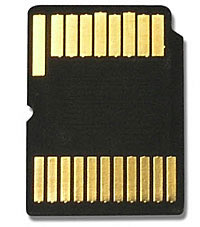 C-Flash has also been submitted to the MMC Association to be considered as the next small form factor standard of MMC.
 MP3-player supplier Jens of Sweden and Jonas Birgersson (founder of broadband supplier Bredband2) have reported the Anti-Piracy Agency to the Swedish Data Inspection Board (SDI).
 Bredband2 has already received queries from the police based on the agency’s registrations.
 Besides, we think that terrorizing and persecuting the users is the wrong method. Instead, we should popularise and support all the great Swedish companies that develop unique digital services. Stop the witch-hunt and support the legal alternatives.”
 The Swedish police have prosecuted 136 people for illegal file sharing after complaints from the AP-agency, and the agency has vowed to increase the number.
 Straight out of the Billy Bonkers School of Barking Inventions, Sony Ericsson’s new Bluetooth controlled camera, ROB-1, lets users steer a wheeled camera around using the joystick or keypad on a mobile phone.
 “This is a great gadget for people who really like testing the latest technology first hand and having fun with new applications. Just like the Sony Ericsson Bluetooth Car which appealed to a wide range of gadget fans, we believe that ROB-1 will become the ‘must have’ Bluetooth gadget to show off to friends and family!!
 MTV in Germany has been demonstrating an interactive TV portal that combines satellite and broadband services.
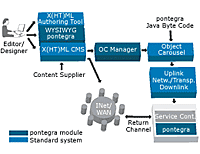 MTV is using Alticast for the technical implementation and broadcast of the interactive service.
 Skype is proudly trumpeting the fact that more than 1,000,000 users have subscribed to SkypeOut, their premium service offering global calling to PSTN numbers for local rates.
 “Our one million SkypeOut users prove that savvy consumers will pay for value – and we will continue to delight users by delivering the software and services they seek to realize the potential of modern communications.”
 Unlike the creative whirlwind that accompanied the dot.com explosion, innovation seems to be a lot slower in the 3G content market.
 ITN news got in on the act too, supplementing their mobile news updates with “today in history” style clips trawled from their vast video archives.