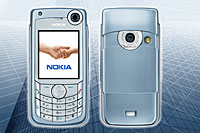
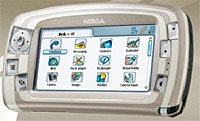
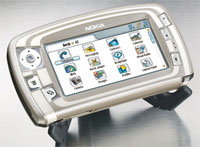
 The Nokia 6680 imaging smartphone has been declared the new ‘Best in Class’ 3G device according to a report by Strategy Analytics.
Four of the best 3G devices currently available in Western European were put under the microscope by Strategy Analytics’ Advanced Wireless Laboratory (AWL) panels in London, UK and Milan, Italy.
All of the phones were assessed on four categories: Video Features, User Interface & Input, Display, and Style/Design, with the Nokia reigning supreme in two categories, Display and Style/Design, as well as registering a joint highest score for User Interface.
When the white-coated, clipboard-toting boffins had finished tallying up the scores, the Nokia 6680 was also the only device to score above the mean score across all four categories.
The 6680 achieved a composite mean rating of 73, compared with 71 for the Sony Ericsson V800, 69 for the Motorola E1000 and 64 for the NEC e338.
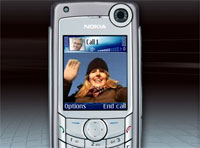 The report noted strong deviations (oo-er!) in the results of these evaluations by gender with the lay-deees preferring the Sony Ericsson and NEC devices, whereas the geezers exhibited a strong preference for the Nokia and Motorola handsets.
“This acknowledgment underscores Nokia’s leadership in 3G devices,” purred Joe Coles, Director of imaging product marketing at Nokia. “The Nokia 6680 is an example of an engineering masterpiece that offers very sophisticated technology combined with ease of use and extremely desirable design. Devices like it pave the way for transforming the way people live, work, play and communicate.”
The Nokia scored particularly well in the Style/Design category, with 98% of participants nominating the phone as the ‘coolest’.
Users were also mightily impressed with the clarity, resolution and brightness of the Nokia 6680 smartphone’s display.
The phone’s User Interface and menu system was considered “logical and easy to use” by the majority of users, with the smartphone scoring highest in the exciting sounding categories of ‘Configuration and Usability of Hot-Buttons’ and ‘Ease of switching between text options’ (who dreams these things up?).
Kevin Nolan, Director of Strategy Analytics’ Advanced Wireless Laboratory commented: “As handset manufacturers compete to launch compelling devices that will meet the demands of the advanced buyers who will drive multimedia content consumption across 3G networks, the Nokia 6680 has set a new standard for performance in terms of usability and device size and style.”
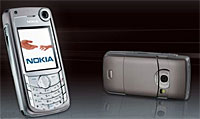 As we announced in March, the Nokia 6680 imaging smartphone comes with a shedload of features including two integrated cameras, a flash, the Nokia XpressPrint printing solution, an active slide for easy camera activation and a bright screen of up to 262,144 colours.
All the vogue Smartphone features are present and correct, with the Nokia sporting an organiser, video streaming, Internet browser, email and 3G-enabled services, such as two-way video calling and video sharing.
As competing handset manufacturers try to catch the eye of consumers by ramping up the gizmos and widgets, it’s important that the phones remain easy to use.
Nokia have acquired a well earned reputation for the simplicity of their interfaces and this writer still rues the day he moved from his Nokia phone to a fiddly-tastic Sony Ericsson.
 More and more people are using computers or portable players for music, even though traditional radio still leads the competition, according to a recent market study.
 Last week, Yahoo revealed their determination to become big noise in the music industry, unveiling a
  Natalie Mouyal of
  Generally, countries have tended mix the two strategies. Viewers have benefited from both an increase in the number of television service programmes available, as well as interactive television services. Yet, this combination has not always allowed for an impressive take-off of MHP based interactive services. In the case of Finland, consumers could choose between a zapper set-top box that allows them to access more television service programmes or an MHP-enabled set-top box that allows them to access both the increased number of television services programmes as well as the interactive services. However, MHP-enabled set-top boxes make up only 5% of all set-top boxes currently purchased.
 It has been assumed that many consumers will invariably prefer the cheaper zapper set-top box to a more expensive MHP-enabled set-top box. However, this reasoning disregards the type of interactive services offered. For example, should viewers find interactive services compelling and easy to use, they may be willing to spend the extra money necessary for an interactive set-top box. Thus, it would seem that consumer education is key to the successful roll-out of interactive services.
 Microsoft has unveiled Windows Mobile 5.0, a new version of its Windows operating system for mobile devices.
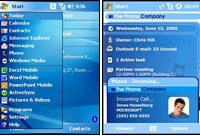 Although the underlying software code remains 90 percent the same as its predecessors, the new Windows Mobile removes some technological distinctions that gave the phone and PDA platforms different capabilities.
 Swivel action business folks will appreciate updates to the mobile versions of Microsoft Word and Excel, with the software providing more consistent formatting of documents created on a computer and allowing charts to be created from a spreadsheet.
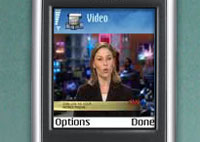
 NTL Broadcast and O2 have revealed the first batch of channels to be part of their forthcoming mobile TV trial in the Oxford area, announcing an initial 16 channels including Cartoon Network, CNN, Discovery Channel, Sky Sports News and Sky Travel.
 To support the trial, NTL Broadcast is building a new broadcast network of eight DVB-H transmitters to cover 120 square km around Oxford that will enable the lucky participants to receive digital television on the move. To enable a commercial service to be launched in the UK, Ofcom will need to license spectrum and O2 is already lobbying the UK regulator to bring forward plans to distribute radio frequencies for mobile TV services.
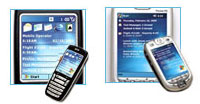 If you’ve ever accessed the Web through a mobile phone or PDA, you may be familiar with the annoyance of finding some sites inaccessible, hard to read or just a right royal pain in the Bluetooth.
 “Mobile access to the Web has been a second-class experience for far too long,” Web founding father and W3C director Tim Berners-Lee said in a statement. “MWI recognizes the mobile device as a first-class participant, and will produce materials to help developers make the mobile Web experience worthwhile.”
 “Web access today is so fundamental, that it shouldn’t be hampered by wires,” table-thumped Philipp Hoschka, W3C’s deputy director for Europe.
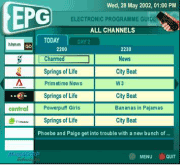 In Austria, a DTT trial with MHP-based interactive services provided 150 households in Graz with access to an interactive television service called !TV4 using the telephone connection for the return channel. Using their television remote control, viewers could retrieve information services and vote. Given the success of the trial, it is likely that MHP-based interactive services will be launched alongside DTT services.
 Of course MHP is not the only interactive television service system in the market. Proprietary systems such as MediaHighway and OpenTV have been installed in a large number of set-top boxes, often for cable and satellite platforms. In the United Kingdom, the MHEG standard is widely used on the terrestrial platform. As a result of the various products and services in the market, the DVB Project has been working on the development of the Portable Content Format (PCF) to deliver a wide range of interactive television services to multiple platforms with a minimum of re-authoring. It has significant interest for operators who wish to migrate towards MHP by allowing them to manage simultaneously a mixed population of devices.
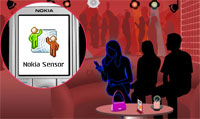 Going up to people and actually introducing yourself has become, like, so uncool with the introduction of the Nokia Sensor Bluetooth widget.
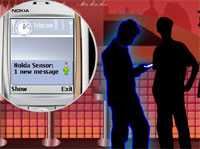 The Sensor app comes with the usual yoof-tastic features, like Buddy Alerts, which tells you if someone you know is nearby (isn’t that what eyes are for?) and ‘Group Codes’ which bleep when someone with similar interests is lurking in the area.
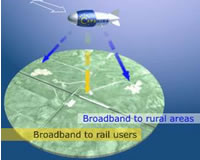 Broadband is taking off everywhere, speeds are increasing and everybody’s happy. Well almost. Broadband isn’t available to all, especially those in more rural areas.
 Other approaches to HAP involve lightweight aircraft, such as the European-funded Capanina project.
 Figures from a new study by ABI Research reveal that annual global sales of “dual-mode” mobile phones – clever-clogs handsets that can connect to either a conventional cellular service or a Wi-Fi network – are likely to exceed 100 million during the final year of this decade.
 Despite all the travelling through different locations, the smartypants handset would sense the available signals and switch automatically from one network mode to another, keeping the user connected at the lowest cost.