 Yahoo’s search engine division has announced that it will be dishing out hardware galore, resources and “critical material aid” to support the non-profit Wikipedia online encyclopedia.
Yahoo Search’s contribution is the most significant received by Wikimedia from a corporate sponsor to date, costed at “several hundred thousand dollars,” by David Mandelbrot, Yahoo’s vice president of search content.
Wikipedia is a global charitable effort, to create and give away a freely licensed encyclopedia in every language of the world.
In just four years, the non profit Wikimedia Foundation has created the largest English language encyclopedia in history, supported by substantial encyclopedias in French, German, and Japanese with “strong efforts underway” in over 100 other languages.
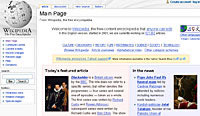
Much like Google’s new Q&A service, Yahoo Search will also feature abstracts of Wikipedia content at the top of relevant search results in the form of “shortcuts,” containing factual information or links to factual information.
Yahoo’s shortcuts are intended to give users the answer they’re looking for on the search results page, saving them the bother of clicking onto other Web sites for the desired information.
Yahoo’s support comes completely free of charge and they will in no way benefit from the positive world-wide publicity or continuing access to Wikipedia content. No sir.
To the strains of “We Are The World” serenading in the background, Mandelbrot explained Yahoo’s generosity, “To operate a site that reaches as many people as Wikipedia can be costly for a non profit, and we’re contributing with resources to help with that effort.”
 “Their popularity is growing very fast and, accordingly, their bandwidth and hardware needs have increased substantially.”
Jimmy Wales, Wikimedia’s president, was naturally well chuffed with the announcement; “Our growth in Web traffic continues to be staggering, doubling every few months. Yahoo’s generous donation to our cause in the form of servers, hosting and bandwidth will have a huge impact on our ability to get our message of sharing knowledge out to the world.”
In a separate statement from Wikimedia, the charity revealed that Yahoo will also be dedicating “a significant number of servers” in a Yahoo facility in Asia.
Yahoo’s profits tripled from $65.3 million (£34.9m/€50.9m) to $253.3 million (£135.4m/€198m) last year.
 Google plans to invite users to submit personal video clips for archiving as part of its recently launched video search service.
 The company also announced that it would provide data about popular Web searches to Current, a new television network for the 18- to 34-year-old audience, backed by former US Vice President Al Gore and other investors.
 A large question mark hangs over the future of aggregated news sites supplied by Web companies such as Google after it was revealed that Agence France-Presse had sued the world’s most popular search engine for alleged copyright infringement.
 “AFP has over 600 online clients using their news services, sites like Political Gateway. Being blacklisted by the number one search engine in the world is enough to make a news site immediately drop AFP and go to another news service like AP, Reuters, UPI, and the like. We know this to be true because Political Gateway is looking at options right now.
 Yahoo has whipped out its wildly wedgified wallet and snapped up the online photo-sharing service Flickr, less than a week after launching a beta test of its new blogging tool.
 There will be some early integration, however, with the ability to log into Flickr using a Yahoo ID and password.
 Internet giants Yahoo are preparing to introduce a new service that blends several of the popular features of its site with two of the Web’s fastest growing activities – blogging and social networking.
 A deal between a search technology company and an online film distributor could be a further step towards the next Big Thing on the Web: search engines that let you find movies and TV episodes by what is said within them – and then buy or rent them.
 With TV networks starting to distribute more of their productions on the Web and the growth of broadband-enabled, home media PCs there’s clearly a growing demand for consumers to be able to access and download content legally.
 Google has added another product to its long list of extended beta services.