There has been some press speculation over the last day or so about mmO2 partnering with DoCoMo to bring their phone and content platform, i-mode, to the UK. Reuters reported that mmO2’s Chief Executive, Peter Erskine, had said last week that the company would decide by year-end on whether to introduce i-mode.
Things appear to have moved on, and this morning the Financial Times is more firm on the story, reporting that O2 will announce the deal next week. They say the service would start next year.
We spoke to mmO2 and their official comment was “the process is ongoing and we are still on schedule to announce before the end of the year”, so no big scoop for us there then. In conversation they did mentioned that the i-mode service has become more attractive over the years, since they last looked at it. Over that time the available range of handsets has increased significantly, it has driven up usage in the markets it has been deployed and the range of content available now for the platform has increased substantially.
[A brief interlude. Why is the company sometimes called mmO2 and other times O2? Let us clear up the confusion. mmO2 is the parent company that operates in a number of countries (UK, Ireland, etc). Its operating units in these countries are called O2. So, parent co=mmO2, local instance=O2.]
i-mode is a huge in Japan, where it has 42m users. Some even credit it with bringing the Internet to the youth of Japan. As home computer ownership previously wasn’t that large, the youth used their phone to get online.
It is already running in four European countries; Germany, France, Italy and Spain, although the take up figures haven’t been what you would call stunning, running at around 4m over the continent. The UK is a big gap in DoCoMo’s European coverage.
For content producers, the most interesting thing about i-mode is its content publishing model. Compared with other mobile platforms in the UK who can take as much as 50-60% of payments made by consumers, i-mode takes significantly less – in the low double digits.
It’s deals like this that are highly likely to draw content to mmO2 – it’s not wholly surprising that content producers will be inclined to get the most income from their wares as possible.
Given the current fashion among 3G watchers is to think that the winners in 3G will be those with the strongest content, a generous share of the income to draw in content owners could be a very smart move by mmO2.
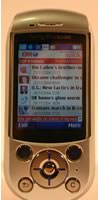 CNN has launched a news service over Europe that delivers the top ten CNN headlines to mobile phones without a subscription charge.
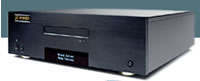 Below are the winners of the Distributed Audio Award (2004) announced at Electronic House Expo in Long Beach, California. Chosen by a panel of five industry experts, they were selected for their innovation, functionality and practicality.
 The BBC will be launching a multi-format campaign starting at the end of November to promote Digital Radio in the run up to Xmas. It’s being previewed in London today.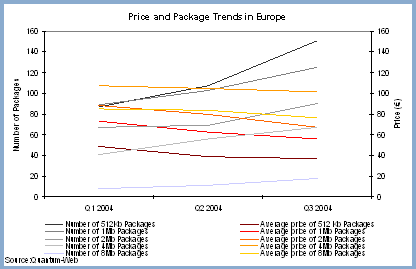
 The opening page (example right) has a video background running on the right and a small number of highlighted options on the left hand side. The layout and links on this page change throughout the day, to match the audience that they think will be looking at it. Currently changing twice it will feature items like horoscopes and lifestyles links during the day and betting and dating in the evening.
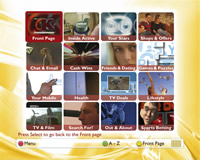 Another way to access the content is via a mosaic layout (example right). This shows a checkerboard of 16 video pieces running on loops. As the viewer uses their remote control to navigate between the videos, bring it in to focus, the audio channel associated with that video loop plays. This short-form video programming is designed to draw people in to the interactive content that lies behind and on pressing the Select key takes them to the content.