US music channel, VH1, carried out a poll of their music buying viewers on the current pricing of CDs, and in particular the price drop Universal Music Group’s (UMG) is instigating from 1 October.
There’s no great surprise to that 72% of them liked the idea and thought it would lead them to buy more CDs.
When asked in detail about the pricing of CDs, 89% thought that current prices were too high and when asked what their expectation was to the prices they should be paying, 43% said $6-$9, 46% felt $10-$13, and 8% thought $14-$17 was reasonable.
Inside the mind of the music downloader
The telephone survey also asked in detail about music downloading and the attitude of those who had downloaded music.
20% of those surveyed admitted to having download music, with 11% having done so in the last six months. Both of these are lower than expected figures and it is highly possible that many people did not admit to having downloaded music given the very public legal action by the Recording Industry Association of America (RIAA) against downloaders. Indeed nearly all of those who had downloaded music were aware of the Recording Industry Association of America’s (RIAA) legal action against downloaders.
As a strong indication to the music companies, this none the less indicative survey revealed that 58% of the downloaders thought a price drop would encourage them to buy more CDs. As is commonly accepted, the survey reported there is a hard core of 13% who said price drops would probably not make any difference and they would not return to buying CDs.
In an indication that the current legal actions might not be steering the buying public in the expected direction, when the downloaders were asked if the threat of lawsuits would prompt them to buy new CDs, only 35% said it was likely, 21% were neutral — and 45% said it was unlikely that the threats would get them to shop for CDs at retail.
The poll was conducted by telephone over a five day period between 17-22 September, 2003 using a random American sample of 1,038 adults aged 18 and older. It was reported that the results have a +/- 3.1% margin of error.
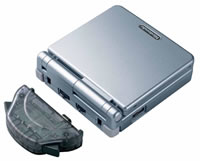 In a move to try and balance the efforts that Nokia are putting in to the N-Gage portable gaming platform, Nintendo has been working closely with Motorola to create a wireless adaptor for the Game Boy Advance and Game Boy Advance SP. The reasonably sized add-on uses the already crowded 2.4GHz band to enable up to five gamers to play against each other.
 They both came into the public eye when they sold an innovative webcasting company, broadcast.com, that they had founded in 1995, to Yahoo! in 1999 for $5.7 billion. Following that avalanche of cash, Cuban went to buy the NBA team Dallas Mavericks, found High Definition TV specialist HDNet and co-found 2929 Entertainment with Wagner.