2005

  • HDTV Support in HP Media Hubs

    CES is coming. Prepare yourself for the flood.

    In an effort to get heard above the noise of CES, HP has this morning announced a couple of products that will be capable of receiving and storing High Definition TV (HDTV).

    The first is an extension to their current Digital Entertainment Center (DEC) range that will add high-definition ATSC (Advanced Television Standards Committee) tuning capabilities. Two models are expected to ship this spring with different storage, graphics card and tuning options.

    The second is the industry’s first HDTV media hub which comes with dual-tuners and expected for release in autumn 2005. It will handle all of the now-expected digital photos, music and videos and act as a digital video recorder (DVR). While HD tuning cards have been available for some time, this is the first time that a mainstream company has announced a HDTV product.

    We contacted HP for further details about the products support for the US Broadcast Flag, but as yet they were unable to provide it. Given the release date of the product is after the July 2005 compulsory support date, and that it’s a US-focused product it is highly likely that the equipment will support the Broadcast Flag.

    Given HP partnership with Philips in the Video Content Protection System (VCPS), an FCC-approved technology designed to restrict the copying of video content to DVD, it is highly likely that this will be included too.

    Of particular interest is HP’s inclusion of an “intuitive Electronic Programming Guide” designed by them to “allow consumers to easily find and record the content they want.” There are no details of this being a free or fee service.

    We see this as HP’s move to become the gateway to access on-demand content of all sorts. This is further demonstrated by their mention of delivering “upgrades the device with new services.” It’s a smart move, placing themselves in this pivotal position before someone else gets in there to provide a service.

    It’s not just computer-based equipment that HP is offering in HD world. They’ve also announced plans to introduce a full line of 17 new HDTVs and home theater projectors based on HP-developed “visual fidelity” technologies.

    One of these is the spectacularly named “wobulation” technology, a patent-pending method to provide twice the resolution of digital projection displays without increasing the cost.
    HP
    ATSC
    VCPS

  • 500GB Hard Drive from Hitachi

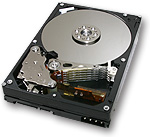
    Hitachi-7k-driveIn an effort to keep up with the demands of the ever growing appetite for digital storage, Hitachi has announced a 500-Gigabyte drive.

    With the rise of Digital Obesity (the hoarding of digital data) and the continued growth of Digital Video Recorders (DVR’s), in particular the early days of availability of the High Definition TV (HDTV) DVRs, the demands for storage are growing drastically.

    The 3.5-inch drive will be joining the DeskStar range of drives as the Deskstar 7K500.

    When used in a DVR it will be able to hold around 200 hours of Standard Definition TV, a serious step up from the 40 to 80 hours now available.

    For those of a hardcore technical nature, you’ll be excited to hear that Hitachi will be the first hard drive vendor to deliver all of the major design enhancements identified in the SATA II (second version of Serial ATA) specification, including a 3 Gb/s data transfer rate. Translated – the serial interface isn’t going to be what slows the path of data from the drive to the processor, that’s more likely to be restricted by the drive (817 Mb/s in this case). SATA II doubles the transfer rate of SATA 1.0.

    The drives also feature what Hitachi is calling Smooth Stream Technology, which is based on the recently ratified ATA-7 AV Streaming Feature Set. Why is this important? It’s been designed to simultaneously lay down a number of large data streams (each HDTV 1080i stream runs at 19 Mbits/s) as well as smoothly handle data errors.

    When handling AV (Audio Visual) information the accuracy of the information is of less importance than its fast transfer. If the video doesn’t arrive in time, the glitches that are seen on the screen are far more noticeable that one or two bits missing

    Hitachi hopes to ship the 7K500 in Q1 2005. Hitachi
    Serial ATA
    ATA-7 Working Draft (doc)
    ATA/ATAPI AV Streaming Command Set Usage Guidelines (doc)

  • TiVoToGo arrives

    TiVo has finally announced the release of the long-anticipated TiVoToGo feature for their series 2 machines. As the name implies, TiVoToGo enables content that has been recorded on the well known Personal Video Recorder (PVR) to be transferred to other devices that support MPEG-2, such as PCs and portable players. Support for playback on many different machines is also provided.

    This will be achieved through a free software upgrade that will be automatically uploaded to subscriber machines over the telephone line. TiVo are being considered and cautious about upgrading the software of remote machines, a wise move in our view. A small number of machines have had the new version deployed to them, to try to ensure any unexpected problems can be handled. Given this, the upgrading of all machines will take quite a while. Those in a rush (most TiVo owners we suspect) can apply for a priority upgrade. Those who register with this are warned that even this priority list will take “a few weeks” to upgrade.

    Software on the receiving PC must also be upgraded to TiVo Desktop 2.0, which only supports Windows XP and 2000. The playback machine must also have a MPEG-2 CoDec installed to view the recordings.

    Network connections on the TiVo will be required, cabled initially, followed by support for some 802.11g adaptors.

    DVD burning supported later

    Although not initially available, burning of the some content to DVD on DVD writer equipped PC’s will be supported.

    TiVo have done a deal with Sonic Solutions, providers of DVD burning software, to provide a special version of Sonic MyDVD, which will be available for purchase. A free trial of this software is available in mid-January 2005.

    Following pressure from the film studios, not all content will be burnable. A point of some controversy amongst many of the TiVo faithful. Content marked with a “don’t burn” flag will be excluded. It is not clear how much, if any, content will not be flagged like this.

    What’s not supported

    While TiVoToGo is a great step forward for TiVo owners, there are a few things that aren’t supported at launch.

    The upgrade will not be available to DIRECTV DVR with TiVo machines, and the same applying to the TiVo Series1 machines.

    Macintosh computers are not initially supported, although it it understood that this will be available later.

    While TiVos with integrated DVD Players will be supported, DVD Recorders with TiVo models from Humax, Toshiba, and Pioneer will not receive the TiVoToGo feature until later this year – probably because they don’t support the “non-copy” flag when burning DVDs.

    In the lead up to the consumer electronics show, CES, TiVo had to bring out this upgrade. As more of the general public become aware of the possibilities of carrying out these functions on their home computers, TiVo’s concern would be that consumers would simply replace their TiVo boxes. Only time will tell if they’ve acted quickly enough.

    TiVoToGo
    Sonic Solutions

  • Samsung HiRes 21-inch OLED screen, Claim Worlds Largest

    Samsung have announced a 21-inch single-panel, Organic Light-Emitting Diode (OLED) display. The 16:9 panel offers WUXGA (Wide Ultra Extended Graphics Array) resolution, providing 1920×1200 pixels. Samsung claim it’s a world first at these resolutions. Seiko Epson showed a multi-panel 40-inch display back in May 2004.

    OLED screens have several advantages over their LCD cousins, primarily the speed of their refresh (around 0.01ms vs 10ms), low power consumption (as they don’t need to be back lit) and a huge contrast ratio (50,000:1).

    In December 2004, Sony and Samsung signed a deal to cross-license what they call “differentiation technology patents”, not their whole related patent portfolio. Our reading of this was “we’ve both spent a lot of time developing our own ideas, and realise that the other side has something of value which we can mutually benefit from.”

    Having missed the trend towards flat screens, Sony have heavily committed to OLED as we covered back in September.

    Samsung

  • iBod from PlayBoy = iPorn

    PlayBoy iBodIt’s not that we’re surprised by this news, but it did send a ripple of laughter around the Digital Lifestyles offices today.

    In this world of new words being made up on what feels like an hourly basis, PlayBoy brings us iBod.

    Not surprisingly, their newly launched service entails delivering photos of scantily clad women to Apple’s Photo iPod. It’s nothing more than that really.

    For years, many have been enthusing about the huge revenues that will come from delivering p0rn to portable devices, based on the one-to-one relationship that people have with them. A few years back, when 3G operators the world over worried about how to make up the huge fees they had paid for the licences, some joked that 3G stood for Girls, Goals and Games.

    Playboy already sells to major wireless markets such as Germany, the United Kingdom, Australia and Brazil. They recently announced that they will now offer the same in the US.

    The fantastically-named Randy Nicolau, president of distribution for the Playboy Entertainment Group said “Given the extraordinary success we’ve had with our wireless offerings around the world, we felt the time was right to expand our wireless content to the millions of U.S. subscribers.”

    To the best of our knowledge the Photo iPod isn’t waterproof, but the Click Wheel is well known for its single hand operation.

    PlayBoy iBod