Ofcom released a consultation document today on ultra wideband (UWB) in the UK.
Given Ofcom’s statutory duties under the Communications Act 2003 to ensure the optimal use of the radio spectrum under its management, they should be keen on UWB.
The strength of UWB also causes its problems. By simultaneously transmitting over a wide range of frequencies (around 3.1 – 10.6GHz, if you’re interested), UWB is able to achieve higher data transfer rate than other wireless technologies.
By spreading over these frequencies it has the possibility of interfering with services that currently operate in or around these services, such as 3G, broadband fixed wireless access and radio astronomy.
Back in May 2004, Ofcom commissioned Mason Communications and DotEcon to produce an independent report in to UWB. Delivered in December 2004 (Read the final report, all 218 pages of PDF fun), it looked at the advantages to the UK economy of allowing UWB applications and the disadvantages of increased interference to existing radio spectrum users.
The report focuses on the use of UWB to create a Personal Area Network (PAN) with examples of usage being; providing wireless connections between DVD players, displays and speakers; and using them for high speed wireless links between digital cameras and computers.
While acknowledging interference is likely, it’s clear that Ofcom feels this should be weighed carefully against UWB’s potential benefits. To check this interference, the suggestion is to use a technical ‘mask’, controlling the amount of power that could be used at different frequencies, in an attempt to reduce the impact of interference.
The US regulator has already authorised UWB on a licence-exempt basis, but Ofcom consider the US specification to be inappropriate for the UK. Their proposal is that if UWB is allowed, it should be on a licence-exempt basis, but be limited to the same in-band power levels as permitted in the US, but have tighter out-of-band limits.
Ofcom point out that there is a need to come to a decision soon, fearing US-built UWB devices could be imported in to the UK.
All of these add up to a big pressure on the frequency users that would be affected. It will be interesting to see what their reaction will be during the consultation period which closes 24 March 2005.
Ofcom Ultra Wideband consultation document
Mason Communications and DotEcon final report
 News International, the publisher of well known UK tabloid ‘newspaper’, The Sun, has opened the doors on its own mobile content service that it calls Sun Mobile.
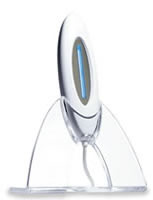 Wow, Griffin Technologies are busy. Following a flood of announcements from them in the build up to MacWorld including the
 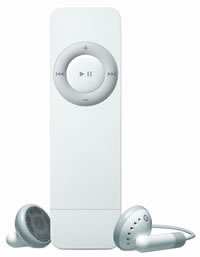 The success of Apple’s iPod range is well known. They have to date sold over 10 million units and have total domination of the hard disk-based portable music players. The only market they weren’t in was the solid state memory, or Flash memory players. To address with the hope of being the winner there too, Jobs announced the Apple iPod shuffle.
 In what isn’t a surprise move Steve Jobs has announced the Apple “Mac Mini”, a low cost addition to the Macintosh computer range. Priced at $499 (~€380, ~£265) and $599 (~€457, ~£319), it can sit in the palm on your hand (measuring 6.5 inches (16.51 cm) square and just 2 inches (5.08 cm) tall and weights just 2.9 pounds (1.32 kg). True to form for Apple, it looks great.
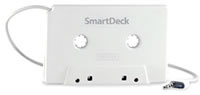 Griffin Technology has announced what they call SmartDeck Intelligent Cassette Technology.
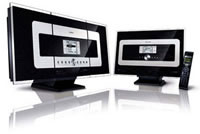 Philips used to strike us as a funny old company. They’ve been tremendously innovative. They had, after all, been a key players in the creation of many pieces of consumer technology; compact cassette; CD; DVD, but their products often looked like a dog’s breakfast.