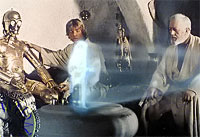
 US scientists have created imaging technology that lets viewers enjoy what they claim to be the first truly three-dimensional holographic movies.
Sadly, the chief boffin of the “holographic television” project, Dr Harold ‘Skip’ Garner, has admitted that the technology will “not be coming soon to a theatre near you”.
Looking into his holographic crystal ball, Garner, professor of biochemistry and internal medicine at the University of Texas Southwestern Medical Center in Dallas, said that he could see the technology being used for entertainment applications like 3D multiplayer games, theme parks, holographic cinema and holographic TV.
Another of the developers, Dr Michael Huebschman, a postdoctoral researcher in Garner’s lab predicted that we’ll all be floating about on hover-boots watching holographic TV in our homes by 2020 (OK, I made the bit up about the boots).
Naturally, the inner gubbins of this device are unfathomably complex, but we can tell you that it’s based on complex optics principles, outrageously clever computer programs, and a small chip covered in more mirrors than Fatty Arbuckle had hot dinners. We’re talking thousands of the things.
Lurking in the heart of the system is a digital light processing micro-mirror chip.
 Made by Texas Instruments, these clever puppies are currently used in television, video and movie projectors and incorporate a computer that processes an incoming digital signal several thousand times a second.
This changes the angle of each micro-mirror to reflect light from a regular light bulb and projects the resulting two-dimensional video onto a screen.
By replacing this light with a laser light and opening up his Big Box Of Clever Ideas, Garner set about creating different wavelengths that were out of phase with each other to create the holographic effect.
The signal created is a sequence of two-dimensional interference patterns, called interferograms, which can be cooked up from scratch or from data gathered from 3-D imaging applications, such as sonograms, CAT scans, magnetic resonance imaging, radar, sonar or computer-aided drafting.
“This technology is potentially powerful for medical applications,” commented Garner. “We could easily take data from existing 3-D imaging technologies and feed that into our computer algorithms to generate two-dimensional interferograms.”
 If you look at interferograms on a PC screen, all you get is a series of random black dots creating an effect that looks a bit like a telly on the blink.
But feed them into the digital light processing micro-mirror chip, blast them at the tiny mirrors and reflect laser light off them and you’re presented with a Star Wars-esque 3-D moving image suspended in air, captured in a special material called agarose gel, or on a stack of liquid crystal plates like computer screens.
Naturally, there’s a ton of really useful applications for this technology that could really benefit mankind: holographic visualisations of human organs, dental and bone development, surgeon training and all that kind of stuff.
But all we want to know is when can we play a holographic shoot-em-up or watch the mighty Cardiff City in glorious surround-o-vision?
Garner and his colleagues whizzed up the technology with students at the Southern Methodist University’s Cox School of Business. The objective was to develop a tentative business plan exploring the possible commercialisation of the technology, with a sensible focus on medical applications and not a desire to see Dot Cotton in 3D.
“An important next step is to take our proof of principle technology that we have now and move it into a commercial entity,” teased Garner before going off to admire a holographic heart.
 Emerging blinking from their underground laboratories, the overworked boffins at Samsung have announced the creation of the SGH-E620 Bluetooth voice recognition phone which is a Bluetooth mobile with – you guessed it! – voice recognition technology.
 Vodafone has made their service more alluring to international business travellers by cutting roaming charges on their 3G data networks.
 According to analysts Gartner, the new prices demonstrate that operators are currently charging too much; “This is a sign that mobile operators are starting to recognise they charge too much for roaming data services,” they added, as your writer’s head nodded vigorously in agreement (while making snarling noises in the direction of T-Mobile).
 Gartner noted that with Vodafone only selling sold 300,000 3G data cards since launching the 3G data network in January 2004, the company is hoping that the reduced roaming charges will boost this figure.
 Apple and the Sundance Channel have signed a deal that will make content from the cable network exclusively available as podcast downloads from the Apple iTunes Web site next month, according to AdAge.
 One of the first iTunes podcast features scheduled for download from the Sundance Channel will be The Al Franken Show who is, apparently, an Air America talk show host.
 The feature in AdAge also reports that Sundance will receive Apple’s post-production editing equipment and expertise as part of the barter deal, with the two companies likely to collaborate on the Apple retail level in the future.